
Key Insights
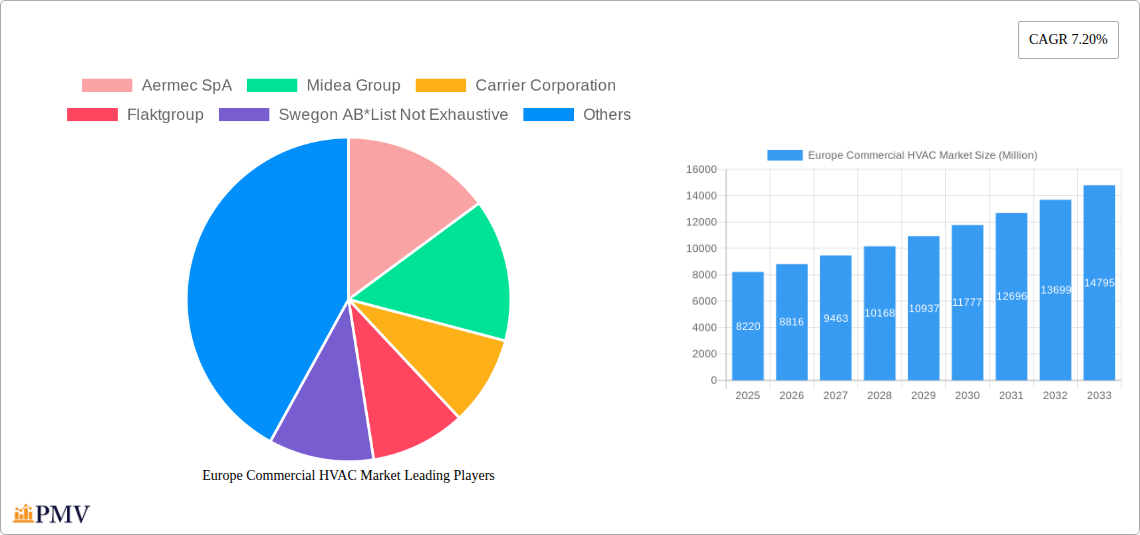
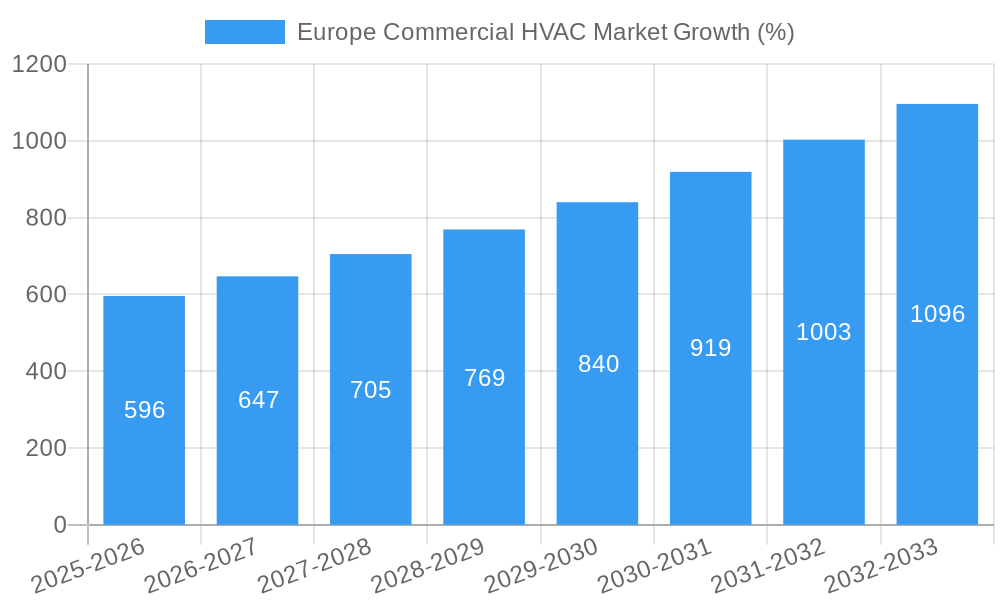
The European commercial HVAC market, valued at €8.22 billion in 2025, is projected to experience robust growth, driven by a Compound Annual Growth Rate (CAGR) of 7.20% from 2025 to 2033. This expansion is fueled by several key factors. Increasing urbanization and the construction of new commercial buildings across major European economies like Germany, France, and the UK are significant contributors. Furthermore, stringent energy efficiency regulations within the EU are compelling businesses to upgrade their existing HVAC systems to more sustainable and energy-saving technologies. The rising adoption of smart building technologies, offering enhanced control and energy optimization, also bolsters market growth. Within the market, segments like HVAC services are witnessing significant traction, driven by the need for regular maintenance and upgrades to ensure optimal system performance and longevity. The hospitality and commercial building sectors remain the largest end-users, indicating a strong reliance on efficient climate control for both customer comfort and operational efficiency.
Competition in the European commercial HVAC market is intense, with established players like Carrier Corporation, Daikin Industries Limited, and Johnson Controls Corporation competing alongside regional players such as Aermec SpA and Swegon AB. The market's future trajectory will be shaped by technological advancements, such as the integration of renewable energy sources and the development of innovative HVAC solutions tailored for specific building types and climates. The ongoing focus on sustainability, coupled with increasing government incentives promoting energy efficiency, is expected to further accelerate market growth throughout the forecast period. Challenges remain, including supply chain disruptions and fluctuations in raw material costs, but the overall market outlook remains positive, driven by the long-term need for efficient and sustainable climate control solutions across Europe's expanding commercial building landscape.
Europe Commercial HVAC Market: A Comprehensive Report (2019-2033)
This in-depth report provides a comprehensive analysis of the Europe Commercial HVAC market, covering the period 2019-2033. It delves into market dynamics, competitive landscapes, key segments, and future growth projections, offering actionable insights for industry stakeholders. With a base year of 2025 and an estimated year of 2025, this report forecasts market trends until 2033, providing a valuable resource for strategic decision-making. The market size is expected to reach xx Million by 2033, exhibiting a CAGR of xx% during the forecast period (2025-2033).
Europe Commercial HVAC Market Structure & Competitive Dynamics
The European Commercial HVAC market is characterized by a moderately concentrated structure with several major players and a multitude of smaller niche competitors. Market share is distributed amongst key players including but not limited to Aermec SpA, Midea Group, Carrier Corporation, Flaktgroup, Swegon AB, Bosch Thermotechnology Corporation, Envirotec Limited, Johnson Controls Corporation, Systemair AB, and Daikin Industries Limited. While precise market share data for each company requires further analysis, Carrier and Daikin are likely to maintain significant market positions due to their extensive product portfolios and global reach.
Innovation ecosystems are flourishing, driven by increasing investments in R&D to develop energy-efficient and sustainable HVAC solutions. Regulatory frameworks, such as the EU's Ecodesign Directive and F-Gas Regulation, are significantly impacting the market by driving the adoption of low-GWP refrigerants and improving energy efficiency standards. Product substitution is evident with the rise of heat pump technology challenging traditional HVAC systems. End-user trends are focused on sustainability, smart building technologies, and improved indoor air quality. M&A activity in the sector has been moderate in recent years, with deal values ranging from xx Million to xx Million, primarily driven by consolidation efforts and the acquisition of specialized technology companies.
Europe Commercial HVAC Market Industry Trends & Insights
The European Commercial HVAC market is experiencing robust growth, fueled by several key trends. The increasing adoption of sustainable and energy-efficient HVAC systems, driven by stringent environmental regulations and rising energy costs, is a significant driver. Technological advancements, such as the integration of IoT and AI in HVAC systems for optimized energy management and predictive maintenance, are further propelling market expansion. Consumer preferences are shifting towards smart, connected systems offering enhanced control and comfort, while building codes and regulations are pushing for higher energy efficiency standards. The competitive landscape is characterized by intense rivalry among established players and the emergence of innovative startups. These factors are collectively contributing to a market exhibiting a compound annual growth rate (CAGR) of xx% during the historical period (2019-2024) and a projected CAGR of xx% during the forecast period (2025-2033). Market penetration of energy-efficient HVAC systems is increasing steadily, with xx% of new commercial buildings expected to adopt these technologies by 2033.
Dominant Markets & Segments in Europe Commercial HVAC Market
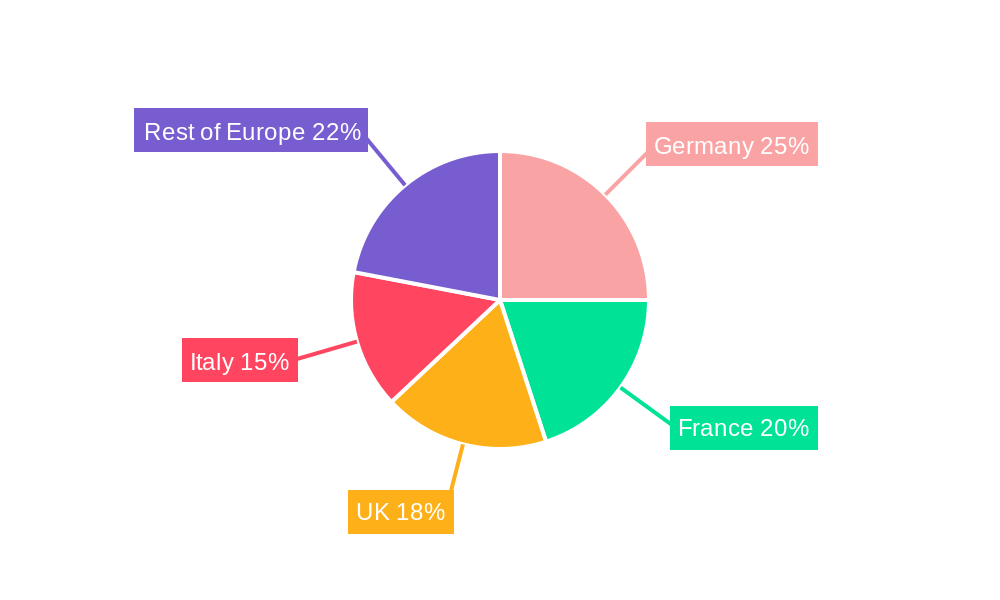
The UK, Germany, France, and Italy are the dominant markets within the European Commercial HVAC sector. The dominance of these countries stems from:
- High Commercial Construction Activity: These countries boast a considerable volume of commercial construction projects, boosting demand for HVAC systems.
- Stringent Environmental Regulations: The implementation of stricter emission standards and energy efficiency regulations are driving the adoption of advanced HVAC technologies.
- Developed Infrastructure: The existing infrastructure in these countries facilitates the installation and maintenance of complex HVAC systems.
- Economic Growth: Stable economies and consistent investment in commercial infrastructure contribute significantly to market growth.
Segment Analysis:
- By Type of Component: HVAC Equipment commands the largest market share owing to its fundamental role in commercial building climate control. Air Conditioning/Ventilation Equipment is also a substantial segment, experiencing strong growth due to heightened focus on indoor air quality. HVAC Services are a crucial part of the market, supporting maintenance and system optimization.
- By End-user Industry: The Commercial Building segment holds the largest share, followed by Public Buildings and Hospitality. Growth in the Commercial Building segment is driven by new constructions and renovations. Public buildings face increasing pressure to enhance energy efficiency, leading to strong demand. The Hospitality sector emphasizes comfort and customer satisfaction, influencing technology adoption and spending.
Europe Commercial HVAC Market Product Innovations
Recent product developments in the European Commercial HVAC market focus heavily on energy efficiency and sustainability. Manufacturers are increasingly incorporating low-GWP refrigerants, advanced heat pump technology, and smart control systems to meet evolving regulatory requirements and consumer demands. These innovations enhance system efficiency, reduce environmental impact, and improve user experience. The integration of IoT and AI capabilities is optimizing system performance, reducing energy consumption, and enabling predictive maintenance, translating into competitive advantages in the market.
Report Segmentation & Scope
This report segments the European Commercial HVAC market based on:
By Type of Component: HVAC Equipment, Air Conditioning/Ventilation Equipment, HVAC Services. Each segment's market size, growth projections, and competitive dynamics are analyzed in detail.
By End-user Industry: Hospitality, Commercial Building, Public Building, Other End-user Industries. Detailed analysis explores the unique requirements and growth potential of each sector.
By Country: United Kingdom, Germany, France, Italy. Each country's market size, growth drivers, and challenges are examined separately. The report provides regional-specific insights into market trends and competitive landscapes.
Key Drivers of Europe Commercial HVAC Market Growth
Several factors drive the growth of the European Commercial HVAC market. Stringent energy efficiency regulations, like the EU's Ecodesign Directive, are pushing the adoption of high-efficiency HVAC systems. The increasing awareness of environmental concerns is also driving the demand for sustainable and low-GWP refrigerant solutions. Economic growth in several European countries fuels investments in commercial construction and building upgrades, thereby boosting the market. Technological advancements, such as smart building technologies and IoT integration, are improving system performance and providing new growth opportunities.
Challenges in the Europe Commercial HVAC Market Sector
The European Commercial HVAC market faces challenges, including stringent regulatory compliance requirements, leading to increased costs for manufacturers. Supply chain disruptions and volatility in raw material prices impact production and profitability. Intense competition among established and emerging players necessitates continuous innovation and investment in R&D. Fluctuations in the economic climate and building construction activity influence market demand, posing uncertainty.
Leading Players in the Europe Commercial HVAC Market Market
- Aermec SpA
- Midea Group
- Carrier Corporation
- Flaktgroup
- Swegon AB
- Bosch Thermotechnology Corporation
- Envirotec Limited
- Johnson Controls Corporation
- Systemair AB
- Daikin Industries Limited
Key Developments in Europe Commercial HVAC Market Sector
May 2024: Lennox International Inc. launched a new range of light commercial HVAC systems using R-454B refrigerant, reducing GWP by up to 78%. This reflects the industry's shift toward sustainable solutions.
March 2024: Midea Building Technologies showcased its MARS series R290 commercial heat pump and the iEasyEnergy energy management system at MCE 2024, highlighting innovation in clean heating and energy management.
Strategic Europe Commercial HVAC Market Outlook
The future of the European Commercial HVAC market is promising. Continued advancements in energy-efficient technologies, coupled with growing environmental awareness and stringent regulations, will drive substantial market growth. Strategic opportunities exist for manufacturers focused on sustainable solutions, smart building technologies, and service-oriented offerings. The market is expected to witness significant expansion, with considerable potential for both established players and new entrants.
Europe Commercial HVAC Market Segmentation
-
1. Type of Component
-
1.1. HVAC Equipment
- 1.1.1. Heating Equipment
- 1.1.2. Air Conditioning/Ventilation Equipment
- 1.2. HVAC Services
-
1.1. HVAC Equipment
-
2. End-user Industry
- 2.1. Hospitality
- 2.2. Commercial Building
- 2.3. Public Building
- 2.4. Other End-user Industries
Europe Commercial HVAC Market Segmentation By Geography
-
1. Europe
- 1.1. United Kingdom
- 1.2. Germany
- 1.3. France
- 1.4. Italy
- 1.5. Spain
- 1.6. Netherlands
- 1.7. Belgium
- 1.8. Sweden
- 1.9. Norway
- 1.10. Poland
- 1.11. Denmark
Europe Commercial HVAC Market REPORT HIGHLIGHTS
| Aspects | Details |
|---|---|
| Study Period | 2019-2033 |
| Base Year | 2024 |
| Estimated Year | 2025 |
| Forecast Period | 2025-2033 |
| Historical Period | 2019-2024 |
| Growth Rate | CAGR of 7.20% from 2019-2033 |
| Segmentation |
|
Table of Contents
- 1. Introduction
- 1.1. Research Scope
- 1.2. Market Segmentation
- 1.3. Research Methodology
- 1.4. Definitions and Assumptions
- 2. Executive Summary
- 2.1. Introduction
- 3. Market Dynamics
- 3.1. Introduction
- 3.2. Market Drivers
- 3.2.1. Increased Construction And Retrofit Activity to Aid Demand; Supportive Government Regulations Including Incentives for Saving Energy through Tax Credit Programs
- 3.3. Market Restrains
- 3.3.1. Higher Installation Costs of Energy-efficient HVAC Systems; Shortage of Skilled Labor
- 3.4. Market Trends
- 3.4.1. HVAC Equipment to Witness a Significant Growth
- 4. Market Factor Analysis
- 4.1. Porters Five Forces
- 4.2. Supply/Value Chain
- 4.3. PESTEL analysis
- 4.4. Market Entropy
- 4.5. Patent/Trademark Analysis
- 5. Europe Commercial HVAC Market Analysis, Insights and Forecast, 2019-2031
- 5.1. Market Analysis, Insights and Forecast - by Type of Component
- 5.1.1. HVAC Equipment
- 5.1.1.1. Heating Equipment
- 5.1.1.2. Air Conditioning/Ventilation Equipment
- 5.1.2. HVAC Services
- 5.1.1. HVAC Equipment
- 5.2. Market Analysis, Insights and Forecast - by End-user Industry
- 5.2.1. Hospitality
- 5.2.2. Commercial Building
- 5.2.3. Public Building
- 5.2.4. Other End-user Industries
- 5.3. Market Analysis, Insights and Forecast - by Region
- 5.3.1. Europe
- 5.1. Market Analysis, Insights and Forecast - by Type of Component
- 6. Germany Europe Commercial HVAC Market Analysis, Insights and Forecast, 2019-2031
- 7. France Europe Commercial HVAC Market Analysis, Insights and Forecast, 2019-2031
- 8. Italy Europe Commercial HVAC Market Analysis, Insights and Forecast, 2019-2031
- 9. United Kingdom Europe Commercial HVAC Market Analysis, Insights and Forecast, 2019-2031
- 10. Netherlands Europe Commercial HVAC Market Analysis, Insights and Forecast, 2019-2031
- 11. Sweden Europe Commercial HVAC Market Analysis, Insights and Forecast, 2019-2031
- 12. Rest of Europe Europe Commercial HVAC Market Analysis, Insights and Forecast, 2019-2031
- 13. Competitive Analysis
- 13.1. Market Share Analysis 2024
- 13.2. Company Profiles
- 13.2.1 Aermec SpA
- 13.2.1.1. Overview
- 13.2.1.2. Products
- 13.2.1.3. SWOT Analysis
- 13.2.1.4. Recent Developments
- 13.2.1.5. Financials (Based on Availability)
- 13.2.2 Midea Group
- 13.2.2.1. Overview
- 13.2.2.2. Products
- 13.2.2.3. SWOT Analysis
- 13.2.2.4. Recent Developments
- 13.2.2.5. Financials (Based on Availability)
- 13.2.3 Carrier Corporation
- 13.2.3.1. Overview
- 13.2.3.2. Products
- 13.2.3.3. SWOT Analysis
- 13.2.3.4. Recent Developments
- 13.2.3.5. Financials (Based on Availability)
- 13.2.4 Flaktgroup
- 13.2.4.1. Overview
- 13.2.4.2. Products
- 13.2.4.3. SWOT Analysis
- 13.2.4.4. Recent Developments
- 13.2.4.5. Financials (Based on Availability)
- 13.2.5 Swegon AB*List Not Exhaustive
- 13.2.5.1. Overview
- 13.2.5.2. Products
- 13.2.5.3. SWOT Analysis
- 13.2.5.4. Recent Developments
- 13.2.5.5. Financials (Based on Availability)
- 13.2.6 Bosch Thermotechnology Corporation
- 13.2.6.1. Overview
- 13.2.6.2. Products
- 13.2.6.3. SWOT Analysis
- 13.2.6.4. Recent Developments
- 13.2.6.5. Financials (Based on Availability)
- 13.2.7 Envirotec Limited
- 13.2.7.1. Overview
- 13.2.7.2. Products
- 13.2.7.3. SWOT Analysis
- 13.2.7.4. Recent Developments
- 13.2.7.5. Financials (Based on Availability)
- 13.2.8 Johnson Controls Corporation
- 13.2.8.1. Overview
- 13.2.8.2. Products
- 13.2.8.3. SWOT Analysis
- 13.2.8.4. Recent Developments
- 13.2.8.5. Financials (Based on Availability)
- 13.2.9 Systemair AB
- 13.2.9.1. Overview
- 13.2.9.2. Products
- 13.2.9.3. SWOT Analysis
- 13.2.9.4. Recent Developments
- 13.2.9.5. Financials (Based on Availability)
- 13.2.10 Daikin Industries Limited
- 13.2.10.1. Overview
- 13.2.10.2. Products
- 13.2.10.3. SWOT Analysis
- 13.2.10.4. Recent Developments
- 13.2.10.5. Financials (Based on Availability)
- 13.2.1 Aermec SpA
List of Figures
- Figure 1: Europe Commercial HVAC Market Revenue Breakdown (Million, %) by Product 2024 & 2032
- Figure 2: Europe Commercial HVAC Market Share (%) by Company 2024
List of Tables
- Table 1: Europe Commercial HVAC Market Revenue Million Forecast, by Region 2019 & 2032
- Table 2: Europe Commercial HVAC Market Revenue Million Forecast, by Type of Component 2019 & 2032
- Table 3: Europe Commercial HVAC Market Revenue Million Forecast, by End-user Industry 2019 & 2032
- Table 4: Europe Commercial HVAC Market Revenue Million Forecast, by Region 2019 & 2032
- Table 5: Europe Commercial HVAC Market Revenue Million Forecast, by Country 2019 & 2032
- Table 6: Germany Europe Commercial HVAC Market Revenue (Million) Forecast, by Application 2019 & 2032
- Table 7: France Europe Commercial HVAC Market Revenue (Million) Forecast, by Application 2019 & 2032
- Table 8: Italy Europe Commercial HVAC Market Revenue (Million) Forecast, by Application 2019 & 2032
- Table 9: United Kingdom Europe Commercial HVAC Market Revenue (Million) Forecast, by Application 2019 & 2032
- Table 10: Netherlands Europe Commercial HVAC Market Revenue (Million) Forecast, by Application 2019 & 2032
- Table 11: Sweden Europe Commercial HVAC Market Revenue (Million) Forecast, by Application 2019 & 2032
- Table 12: Rest of Europe Europe Commercial HVAC Market Revenue (Million) Forecast, by Application 2019 & 2032
- Table 13: Europe Commercial HVAC Market Revenue Million Forecast, by Type of Component 2019 & 2032
- Table 14: Europe Commercial HVAC Market Revenue Million Forecast, by End-user Industry 2019 & 2032
- Table 15: Europe Commercial HVAC Market Revenue Million Forecast, by Country 2019 & 2032
- Table 16: United Kingdom Europe Commercial HVAC Market Revenue (Million) Forecast, by Application 2019 & 2032
- Table 17: Germany Europe Commercial HVAC Market Revenue (Million) Forecast, by Application 2019 & 2032
- Table 18: France Europe Commercial HVAC Market Revenue (Million) Forecast, by Application 2019 & 2032
- Table 19: Italy Europe Commercial HVAC Market Revenue (Million) Forecast, by Application 2019 & 2032
- Table 20: Spain Europe Commercial HVAC Market Revenue (Million) Forecast, by Application 2019 & 2032
- Table 21: Netherlands Europe Commercial HVAC Market Revenue (Million) Forecast, by Application 2019 & 2032
- Table 22: Belgium Europe Commercial HVAC Market Revenue (Million) Forecast, by Application 2019 & 2032
- Table 23: Sweden Europe Commercial HVAC Market Revenue (Million) Forecast, by Application 2019 & 2032
- Table 24: Norway Europe Commercial HVAC Market Revenue (Million) Forecast, by Application 2019 & 2032
- Table 25: Poland Europe Commercial HVAC Market Revenue (Million) Forecast, by Application 2019 & 2032
- Table 26: Denmark Europe Commercial HVAC Market Revenue (Million) Forecast, by Application 2019 & 2032
Frequently Asked Questions
1. What is the projected Compound Annual Growth Rate (CAGR) of the Europe Commercial HVAC Market?
The projected CAGR is approximately 7.20%.
2. Which companies are prominent players in the Europe Commercial HVAC Market?
Key companies in the market include Aermec SpA, Midea Group, Carrier Corporation, Flaktgroup, Swegon AB*List Not Exhaustive, Bosch Thermotechnology Corporation, Envirotec Limited, Johnson Controls Corporation, Systemair AB, Daikin Industries Limited.
3. What are the main segments of the Europe Commercial HVAC Market?
The market segments include Type of Component, End-user Industry.
4. Can you provide details about the market size?
The market size is estimated to be USD 8.22 Million as of 2022.
5. What are some drivers contributing to market growth?
Increased Construction And Retrofit Activity to Aid Demand; Supportive Government Regulations Including Incentives for Saving Energy through Tax Credit Programs.
6. What are the notable trends driving market growth?
HVAC Equipment to Witness a Significant Growth.
7. Are there any restraints impacting market growth?
Higher Installation Costs of Energy-efficient HVAC Systems; Shortage of Skilled Labor.
8. Can you provide examples of recent developments in the market?
May 2024: Lennox International Inc., a company offering climate control solutions, revealed the launch of a new range of HVAC products, including refrigerants with low global warming potential (GWP). This move was in line with the company's dedication to sustainability and in preparation for the 2025 requirements that will require the utilization of refrigerants with low GWP. The new series will consist of light commercial HVAC systems that will use R-454B refrigerant, which has a lower global warming potential of up to 78% compared to standard refrigerants.
9. What pricing options are available for accessing the report?
Pricing options include single-user, multi-user, and enterprise licenses priced at USD 4750, USD 4950, and USD 6800 respectively.
10. Is the market size provided in terms of value or volume?
The market size is provided in terms of value, measured in Million.
11. Are there any specific market keywords associated with the report?
Yes, the market keyword associated with the report is "Europe Commercial HVAC Market," which aids in identifying and referencing the specific market segment covered.
12. How do I determine which pricing option suits my needs best?
The pricing options vary based on user requirements and access needs. Individual users may opt for single-user licenses, while businesses requiring broader access may choose multi-user or enterprise licenses for cost-effective access to the report.
13. Are there any additional resources or data provided in the Europe Commercial HVAC Market report?
While the report offers comprehensive insights, it's advisable to review the specific contents or supplementary materials provided to ascertain if additional resources or data are available.
14. How can I stay updated on further developments or reports in the Europe Commercial HVAC Market?
To stay informed about further developments, trends, and reports in the Europe Commercial HVAC Market, consider subscribing to industry newsletters, following relevant companies and organizations, or regularly checking reputable industry news sources and publications.
Methodology
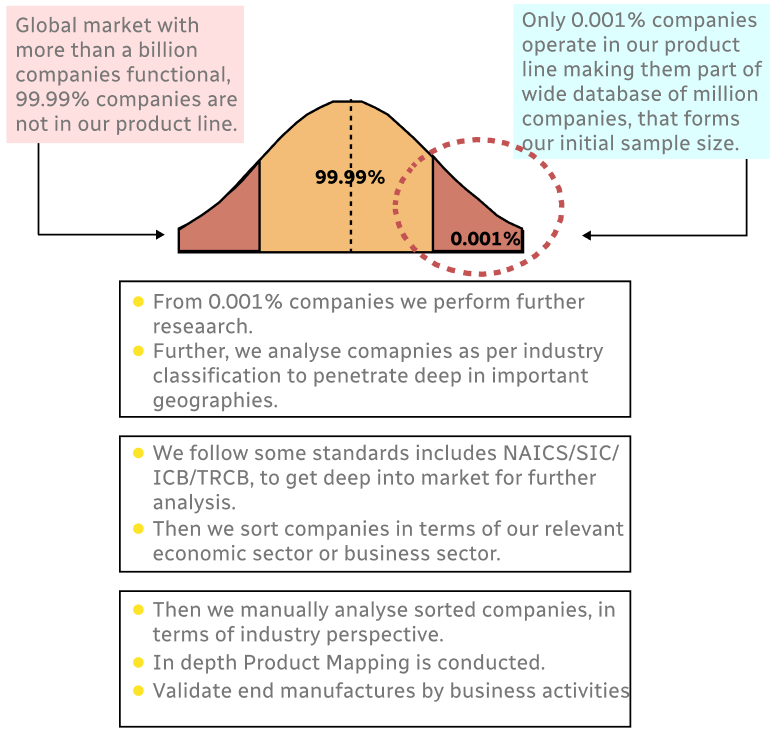
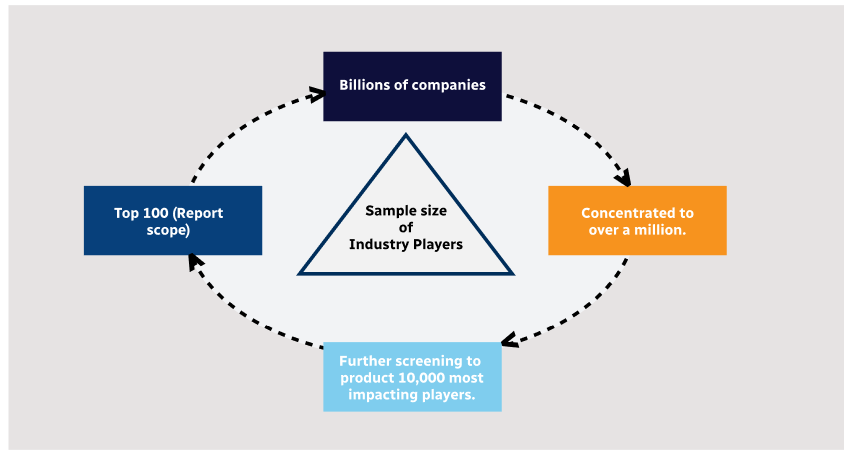
Step 1 - Identification of Relevant Samples Size from Population Database
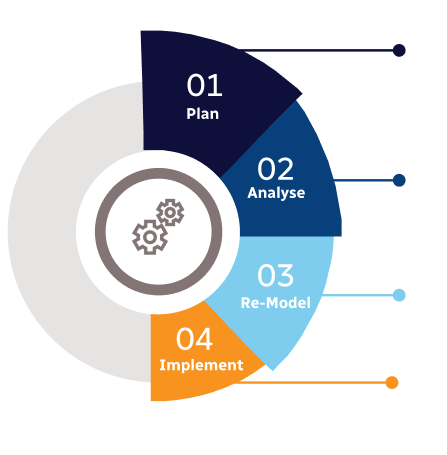
Step 2 - Approaches for Defining Global Market Size (Value, Volume* & Price*)
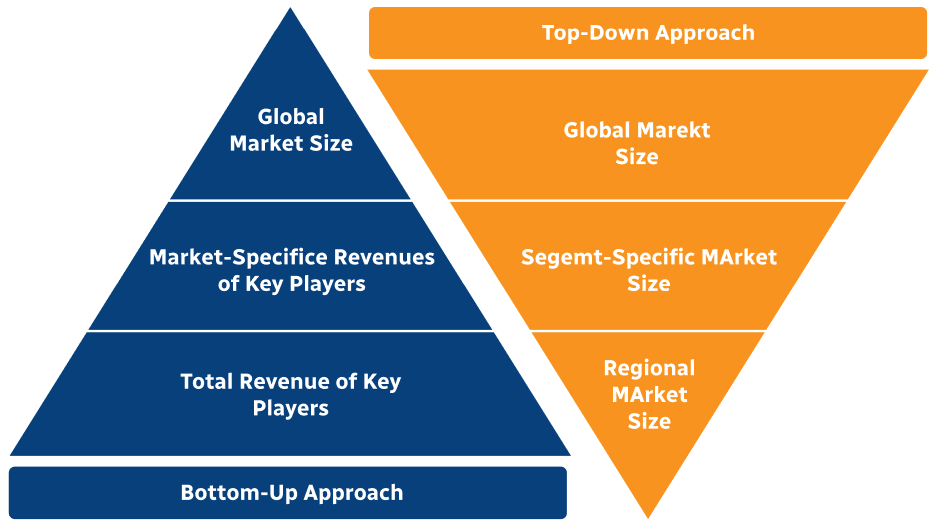
Note*: In applicable scenarios
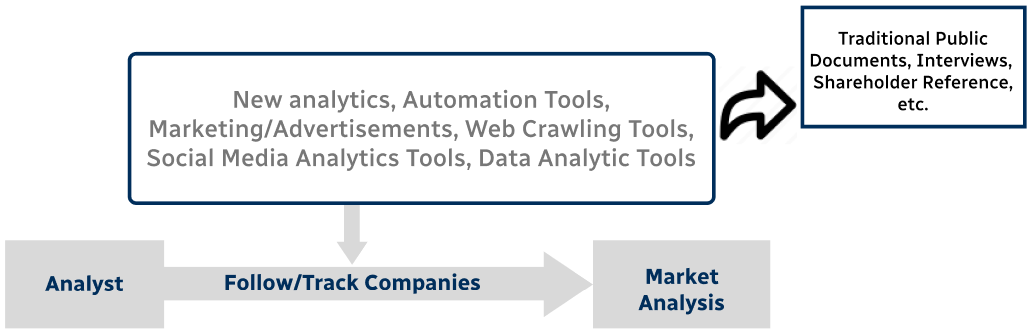
Step 3 - Data Sources
Primary Research
- Web Analytics
- Survey Reports
- Research Institute
- Latest Research Reports
- Opinion Leaders
Secondary Research
- Annual Reports
- White Paper
- Latest Press Release
- Industry Association
- Paid Database
- Investor Presentations
Step 4 - Data Triangulation
Involves using different sources of information in order to increase the validity of a study
These sources are likely to be stakeholders in a program - participants, other researchers, program staff, other community members, and so on.
Then we put all data in single framework & apply various statistical tools to find out the dynamic on the market.
During the analysis stage, feedback from the stakeholder groups would be compared to determine areas of agreement as well as areas of divergence