


Key Insights
The Cardiac Computed Tomography (CCT) market is poised for significant expansion, projected to reach $6.13 billion by 2025, with an impressive Compound Annual Growth Rate (CAGR) of 14.27% from the base year 2025 to 2033. This robust growth is primarily attributed to the escalating global burden of cardiovascular diseases (CVDs), coupled with continuous advancements in imaging technology that deliver superior resolution and expedited scan times. The increasing preference for minimally invasive diagnostic pathways further fuels market demand. Key growth drivers include the adoption of advanced CCT technologies such as dual-source CT and iterative reconstruction techniques, which enhance image clarity and minimize radiation exposure. The seamless integration of CCT with sophisticated analytical software for optimized workflow efficiency also contributes to market expansion. An aging global demographic, a known risk factor for CVDs, directly translates to a rising demand for precise and effective diagnostic tools like CCT. Intense competition among leading industry players and sustained research and development initiatives, particularly in AI-driven image analysis, are further accelerating market growth.
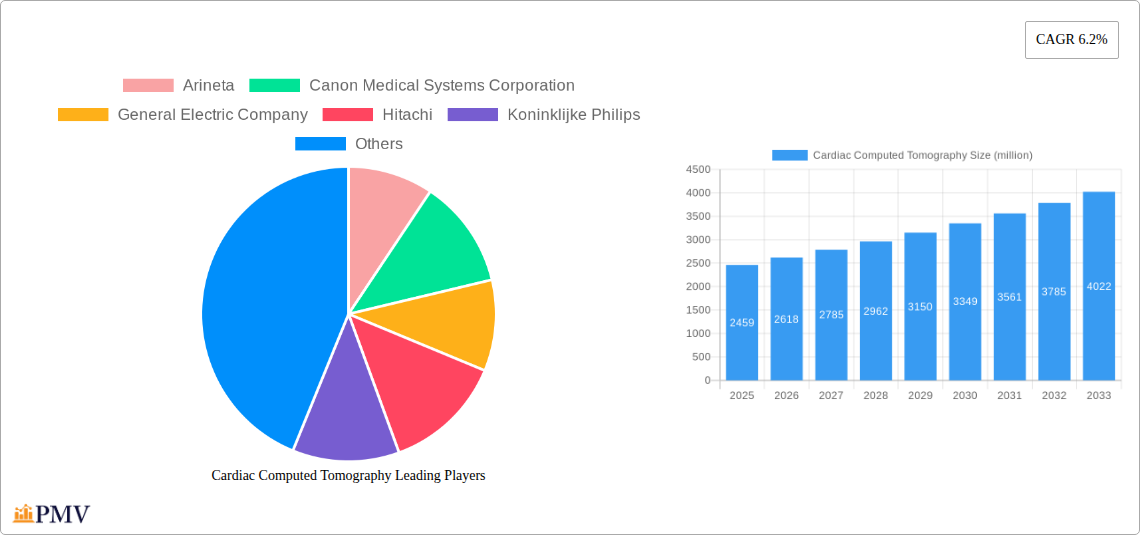
Cardiac Computed Tomography Market Size (In Billion)

Despite the positive trajectory, certain constraints warrant consideration. The substantial capital expenditure required for CCT system acquisition and upkeep presents a challenge for smaller healthcare providers. Stringent regulatory approvals and varying reimbursement policies across different geographies can impede market adoption. While technological innovations have significantly reduced radiation exposure, persistent concerns can still influence utilization rates. Nonetheless, the outlook for the CCT market remains overwhelmingly positive, underpinned by its demonstrable clinical advantages and ongoing technological innovation. Future market evolution is anticipated to involve further segmentation by technology, application, and end-user, with the emergence of specialized systems and software tailored to specific clinical requirements.
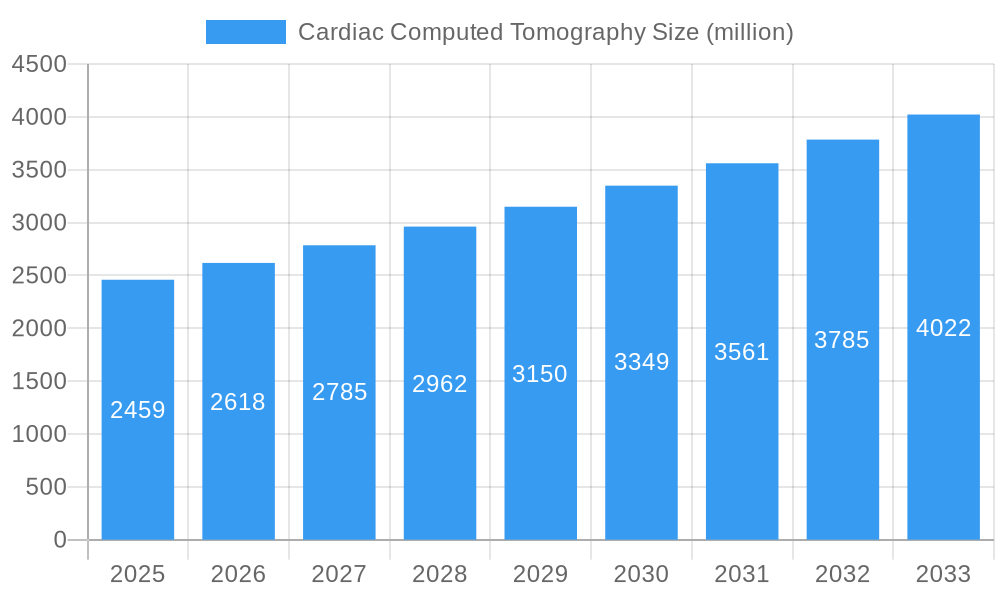
Cardiac Computed Tomography Company Market Share
Cardiac Computed Tomography (CCT) Market Report: 2019-2033
This comprehensive report provides a detailed analysis of the global Cardiac Computed Tomography (CCT) market, offering invaluable insights for industry stakeholders, investors, and researchers. The report covers the period 2019-2033, with a focus on the 2025-2033 forecast period. The market is projected to reach xx million by 2033, exhibiting a CAGR of xx% during the forecast period. This in-depth analysis examines market structure, competitive dynamics, technological advancements, and key growth drivers, offering actionable intelligence to navigate this rapidly evolving landscape.
Cardiac Computed Tomography Market Structure & Competitive Dynamics
The global Cardiac Computed Tomography market exhibits a moderately concentrated structure, with key players like General Electric Company, Siemens Healthcare GmbH, and Koninklijke Philips holding significant market share. However, the presence of several other established players, including Canon Medical Systems Corporation, Hitachi, Fujifilm Corporation, Medtronic, and Mindray Medical International Limited, creates a competitive environment. The market's innovation ecosystem is characterized by continuous advancements in image processing, detector technology, and AI-powered diagnostic tools.
Regulatory frameworks, particularly those concerning medical device approvals and data privacy, significantly impact market dynamics. Product substitutes, such as cardiac MRI and echocardiography, pose some competitive pressure, although CCT retains a significant advantage in certain applications. End-user trends reflect a growing demand for faster, more accurate, and less invasive diagnostic procedures. Mergers and acquisitions (M&A) activity in the sector has been moderate, with deal values exceeding xx million in recent years, primarily focused on enhancing technological capabilities and expanding market reach. For example, xx% market share is held by the top 5 players in 2025, which are expected to account for xx million of revenue.
- Market Concentration: Moderately concentrated
- M&A Activity: Moderate, with deal values exceeding xx million.
- Key Players Market Share: Top 5 players hold xx% of market share in 2025.
Cardiac Computed Tomography Industry Trends & Insights
The global Cardiac Computed Tomography market is experiencing robust growth, driven by several key factors. The increasing prevalence of cardiovascular diseases globally is a primary driver, fueling the demand for advanced diagnostic tools. Technological advancements, such as iterative reconstruction techniques and AI-powered image analysis, are enhancing the accuracy and speed of CCT scans. The continuous development of dual-source and multi-slice CT scanners is increasing the efficiency of scans. Consumer preferences are shifting towards minimally invasive diagnostic procedures, favoring CCT over traditional methods. The growing adoption of CCT in preventative healthcare also contributes to market expansion. This is driving a steady increase in market revenue and penetration. The market's estimated size in 2025 is xx million, and it is projected to reach xx million by 2033, with a CAGR of xx%. The market penetration rate is estimated to be xx% in 2025, expected to increase to xx% by 2033.
Dominant Markets & Segments in Cardiac Computed Tomography
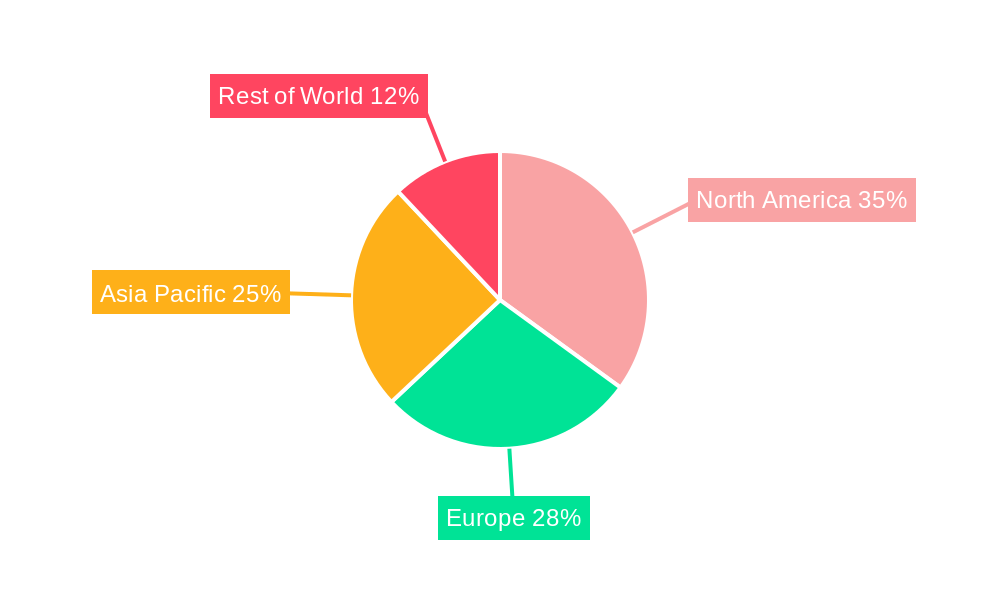
North America currently holds a dominant position in the global Cardiac Computed Tomography market, driven by factors such as advanced healthcare infrastructure, high adoption rates, and favorable regulatory policies. The region's substantial investment in healthcare technology, coupled with a high prevalence of cardiovascular diseases, contributes to its market leadership.
- Key Drivers in North America:
- Advanced healthcare infrastructure.
- High adoption rates of advanced imaging technologies.
- Favorable regulatory policies.
- Substantial investment in healthcare technology.
- High prevalence of cardiovascular diseases.
Europe and Asia Pacific are also significant markets, experiencing substantial growth due to rising healthcare expenditure, increasing awareness of cardiovascular health, and expanding healthcare infrastructure. However, challenges remain, including uneven access to advanced healthcare in some regions, and high costs of advanced imaging technologies are preventing complete saturation. The detailed analysis within this report will uncover those challenges and estimate the specific revenue contribution of each region and segment.
Cardiac Computed Tomography Product Innovations
Recent product innovations in Cardiac Computed Tomography focus on improving image quality, reducing radiation dose, and enhancing workflow efficiency. Developments include advanced iterative reconstruction algorithms, dual-source CT scanners with faster scan times, and AI-powered image analysis tools for automated detection of cardiac anomalies. These innovations are improving diagnostic accuracy and reducing the time required for image interpretation. These factors are contributing to improved market penetration of these CCT solutions within the healthcare sector.
Report Segmentation & Scope
This report segments the Cardiac Computed Tomography market by various factors, including:
- By Product Type: This segment covers different types of CCT systems available.
- By End-User: This includes hospitals, diagnostic imaging centers, and ambulatory surgical centers.
- By Region: The report provides a detailed regional breakdown, covering North America, Europe, Asia Pacific, and the rest of the world.
- Each segment's projected growth, market size, and competitive dynamics are analyzed in detail.
Key Drivers of Cardiac Computed Tomography Growth
Several factors contribute to the growth of the Cardiac Computed Tomography market. The rising prevalence of cardiovascular diseases, technological advancements (e.g., AI-powered diagnostics), and increasing healthcare expenditure are significant drivers. Favorable regulatory environments in several regions also support market expansion.
Challenges in the Cardiac Computed Tomography Sector
Despite promising growth prospects, the Cardiac Computed Tomography sector faces challenges such as high initial investment costs for equipment, stringent regulatory approvals for new technologies, and the potential for competition from alternative diagnostic methods. Furthermore, supply chain disruptions and skilled labor shortages can pose further challenges.
Leading Players in the Cardiac Computed Tomography Market
- Arineta
- Canon Medical Systems Corporation
- General Electric Company
- Hitachi
- Koninklijke Philips
- Neusoft Corporation
- Siemens Healthcare GmbH
- Fujifilm Corporation
- Neurologica Corp
- Samsung
- Shenzhen Anke High-Tech Co.
- Carestream Health
- Agfa-Gevaert Group
- Hologic, Inc.
- Shimadzu Corporation
- Medtronic
- Esaote S.p.A.
- Mindray Medical International Limited
Key Developments in Cardiac Computed Tomography Sector
- 2022-Q4: Company X launched a new AI-powered image analysis software for CCT.
- 2023-Q1: Company Y announced the acquisition of Company Z, expanding its product portfolio in the CCT space.
- 2023-Q2: New regulatory approvals granted for advanced CCT technology in key markets. (Further details will be provided within the full report)
Strategic Cardiac Computed Tomography Market Outlook
The Cardiac Computed Tomography market holds significant future potential. Continued technological advancements, coupled with the increasing prevalence of cardiovascular diseases, will drive substantial growth. Strategic opportunities lie in developing innovative solutions, expanding into emerging markets, and focusing on value-based healthcare models. The market is poised for continued expansion, presenting lucrative prospects for established players and new entrants alike.
Cardiac Computed Tomography Segmentation
-
1. Application
- 1.1. Hospital
- 1.2. Clinic
- 1.3. Other
-
2. Types
- 2.1. Low Slice
- 2.2. Medium Slice
- 2.3. High Slice
Cardiac Computed Tomography Segmentation By Geography
-
1. North America
- 1.1. United States
- 1.2. Canada
- 1.3. Mexico
-
2. South America
- 2.1. Brazil
- 2.2. Argentina
- 2.3. Rest of South America
-
3. Europe
- 3.1. United Kingdom
- 3.2. Germany
- 3.3. France
- 3.4. Italy
- 3.5. Spain
- 3.6. Russia
- 3.7. Benelux
- 3.8. Nordics
- 3.9. Rest of Europe
-
4. Middle East & Africa
- 4.1. Turkey
- 4.2. Israel
- 4.3. GCC
- 4.4. North Africa
- 4.5. South Africa
- 4.6. Rest of Middle East & Africa
-
5. Asia Pacific
- 5.1. China
- 5.2. India
- 5.3. Japan
- 5.4. South Korea
- 5.5. ASEAN
- 5.6. Oceania
- 5.7. Rest of Asia Pacific
Cardiac Computed Tomography Regional Market Share
Geographic Coverage of Cardiac Computed Tomography
Cardiac Computed Tomography REPORT HIGHLIGHTS
| Aspects | Details |
|---|---|
| Study Period | 2020-2034 |
| Base Year | 2025 |
| Estimated Year | 2026 |
| Forecast Period | 2026-2034 |
| Historical Period | 2020-2025 |
| Growth Rate | CAGR of 14.27% from 2020-2034 |
| Segmentation |
|
Table of Contents
- 1. Introduction
- 1.1. Research Scope
- 1.2. Market Segmentation
- 1.3. Research Methodology
- 1.4. Definitions and Assumptions
- 2. Executive Summary
- 2.1. Introduction
- 3. Market Dynamics
- 3.1. Introduction
- 3.2. Market Drivers
- 3.3. Market Restrains
- 3.4. Market Trends
- 4. Market Factor Analysis
- 4.1. Porters Five Forces
- 4.2. Supply/Value Chain
- 4.3. PESTEL analysis
- 4.4. Market Entropy
- 4.5. Patent/Trademark Analysis
- 5. Global Cardiac Computed Tomography Analysis, Insights and Forecast, 2020-2032
- 5.1. Market Analysis, Insights and Forecast - by Application
- 5.1.1. Hospital
- 5.1.2. Clinic
- 5.1.3. Other
- 5.2. Market Analysis, Insights and Forecast - by Types
- 5.2.1. Low Slice
- 5.2.2. Medium Slice
- 5.2.3. High Slice
- 5.3. Market Analysis, Insights and Forecast - by Region
- 5.3.1. North America
- 5.3.2. South America
- 5.3.3. Europe
- 5.3.4. Middle East & Africa
- 5.3.5. Asia Pacific
- 5.1. Market Analysis, Insights and Forecast - by Application
- 6. North America Cardiac Computed Tomography Analysis, Insights and Forecast, 2020-2032
- 6.1. Market Analysis, Insights and Forecast - by Application
- 6.1.1. Hospital
- 6.1.2. Clinic
- 6.1.3. Other
- 6.2. Market Analysis, Insights and Forecast - by Types
- 6.2.1. Low Slice
- 6.2.2. Medium Slice
- 6.2.3. High Slice
- 6.1. Market Analysis, Insights and Forecast - by Application
- 7. South America Cardiac Computed Tomography Analysis, Insights and Forecast, 2020-2032
- 7.1. Market Analysis, Insights and Forecast - by Application
- 7.1.1. Hospital
- 7.1.2. Clinic
- 7.1.3. Other
- 7.2. Market Analysis, Insights and Forecast - by Types
- 7.2.1. Low Slice
- 7.2.2. Medium Slice
- 7.2.3. High Slice
- 7.1. Market Analysis, Insights and Forecast - by Application
- 8. Europe Cardiac Computed Tomography Analysis, Insights and Forecast, 2020-2032
- 8.1. Market Analysis, Insights and Forecast - by Application
- 8.1.1. Hospital
- 8.1.2. Clinic
- 8.1.3. Other
- 8.2. Market Analysis, Insights and Forecast - by Types
- 8.2.1. Low Slice
- 8.2.2. Medium Slice
- 8.2.3. High Slice
- 8.1. Market Analysis, Insights and Forecast - by Application
- 9. Middle East & Africa Cardiac Computed Tomography Analysis, Insights and Forecast, 2020-2032
- 9.1. Market Analysis, Insights and Forecast - by Application
- 9.1.1. Hospital
- 9.1.2. Clinic
- 9.1.3. Other
- 9.2. Market Analysis, Insights and Forecast - by Types
- 9.2.1. Low Slice
- 9.2.2. Medium Slice
- 9.2.3. High Slice
- 9.1. Market Analysis, Insights and Forecast - by Application
- 10. Asia Pacific Cardiac Computed Tomography Analysis, Insights and Forecast, 2020-2032
- 10.1. Market Analysis, Insights and Forecast - by Application
- 10.1.1. Hospital
- 10.1.2. Clinic
- 10.1.3. Other
- 10.2. Market Analysis, Insights and Forecast - by Types
- 10.2.1. Low Slice
- 10.2.2. Medium Slice
- 10.2.3. High Slice
- 10.1. Market Analysis, Insights and Forecast - by Application
- 11. Competitive Analysis
- 11.1. Global Market Share Analysis 2025
- 11.2. Company Profiles
- 11.2.1 Arineta
- 11.2.1.1. Overview
- 11.2.1.2. Products
- 11.2.1.3. SWOT Analysis
- 11.2.1.4. Recent Developments
- 11.2.1.5. Financials (Based on Availability)
- 11.2.2 Canon Medical Systems Corporation
- 11.2.2.1. Overview
- 11.2.2.2. Products
- 11.2.2.3. SWOT Analysis
- 11.2.2.4. Recent Developments
- 11.2.2.5. Financials (Based on Availability)
- 11.2.3 General Electric Company
- 11.2.3.1. Overview
- 11.2.3.2. Products
- 11.2.3.3. SWOT Analysis
- 11.2.3.4. Recent Developments
- 11.2.3.5. Financials (Based on Availability)
- 11.2.4 Hitachi
- 11.2.4.1. Overview
- 11.2.4.2. Products
- 11.2.4.3. SWOT Analysis
- 11.2.4.4. Recent Developments
- 11.2.4.5. Financials (Based on Availability)
- 11.2.5 Koninklijke Philips
- 11.2.5.1. Overview
- 11.2.5.2. Products
- 11.2.5.3. SWOT Analysis
- 11.2.5.4. Recent Developments
- 11.2.5.5. Financials (Based on Availability)
- 11.2.6 Neusoft Corporation
- 11.2.6.1. Overview
- 11.2.6.2. Products
- 11.2.6.3. SWOT Analysis
- 11.2.6.4. Recent Developments
- 11.2.6.5. Financials (Based on Availability)
- 11.2.7 Siemens Healthcare Gmbh
- 11.2.7.1. Overview
- 11.2.7.2. Products
- 11.2.7.3. SWOT Analysis
- 11.2.7.4. Recent Developments
- 11.2.7.5. Financials (Based on Availability)
- 11.2.8 Fujifilm Corporation
- 11.2.8.1. Overview
- 11.2.8.2. Products
- 11.2.8.3. SWOT Analysis
- 11.2.8.4. Recent Developments
- 11.2.8.5. Financials (Based on Availability)
- 11.2.9 Neurologica Corp
- 11.2.9.1. Overview
- 11.2.9.2. Products
- 11.2.9.3. SWOT Analysis
- 11.2.9.4. Recent Developments
- 11.2.9.5. Financials (Based on Availability)
- 11.2.10 Samsung
- 11.2.10.1. Overview
- 11.2.10.2. Products
- 11.2.10.3. SWOT Analysis
- 11.2.10.4. Recent Developments
- 11.2.10.5. Financials (Based on Availability)
- 11.2.11 Shenzhen Anke High-Tech Co.
- 11.2.11.1. Overview
- 11.2.11.2. Products
- 11.2.11.3. SWOT Analysis
- 11.2.11.4. Recent Developments
- 11.2.11.5. Financials (Based on Availability)
- 11.2.12 Carestream Health
- 11.2.12.1. Overview
- 11.2.12.2. Products
- 11.2.12.3. SWOT Analysis
- 11.2.12.4. Recent Developments
- 11.2.12.5. Financials (Based on Availability)
- 11.2.13 Agfa-Gevaert Group
- 11.2.13.1. Overview
- 11.2.13.2. Products
- 11.2.13.3. SWOT Analysis
- 11.2.13.4. Recent Developments
- 11.2.13.5. Financials (Based on Availability)
- 11.2.14 Hologic
- 11.2.14.1. Overview
- 11.2.14.2. Products
- 11.2.14.3. SWOT Analysis
- 11.2.14.4. Recent Developments
- 11.2.14.5. Financials (Based on Availability)
- 11.2.15 Inc.
- 11.2.15.1. Overview
- 11.2.15.2. Products
- 11.2.15.3. SWOT Analysis
- 11.2.15.4. Recent Developments
- 11.2.15.5. Financials (Based on Availability)
- 11.2.16 Shimadzu Corporation
- 11.2.16.1. Overview
- 11.2.16.2. Products
- 11.2.16.3. SWOT Analysis
- 11.2.16.4. Recent Developments
- 11.2.16.5. Financials (Based on Availability)
- 11.2.17 Medtronic
- 11.2.17.1. Overview
- 11.2.17.2. Products
- 11.2.17.3. SWOT Analysis
- 11.2.17.4. Recent Developments
- 11.2.17.5. Financials (Based on Availability)
- 11.2.18 Esaote S.p.A.
- 11.2.18.1. Overview
- 11.2.18.2. Products
- 11.2.18.3. SWOT Analysis
- 11.2.18.4. Recent Developments
- 11.2.18.5. Financials (Based on Availability)
- 11.2.19 Mindray Medical International Limited
- 11.2.19.1. Overview
- 11.2.19.2. Products
- 11.2.19.3. SWOT Analysis
- 11.2.19.4. Recent Developments
- 11.2.19.5. Financials (Based on Availability)
- 11.2.1 Arineta
List of Figures
- Figure 1: Global Cardiac Computed Tomography Revenue Breakdown (billion, %) by Region 2025 & 2033
- Figure 2: North America Cardiac Computed Tomography Revenue (billion), by Application 2025 & 2033
- Figure 3: North America Cardiac Computed Tomography Revenue Share (%), by Application 2025 & 2033
- Figure 4: North America Cardiac Computed Tomography Revenue (billion), by Types 2025 & 2033
- Figure 5: North America Cardiac Computed Tomography Revenue Share (%), by Types 2025 & 2033
- Figure 6: North America Cardiac Computed Tomography Revenue (billion), by Country 2025 & 2033
- Figure 7: North America Cardiac Computed Tomography Revenue Share (%), by Country 2025 & 2033
- Figure 8: South America Cardiac Computed Tomography Revenue (billion), by Application 2025 & 2033
- Figure 9: South America Cardiac Computed Tomography Revenue Share (%), by Application 2025 & 2033
- Figure 10: South America Cardiac Computed Tomography Revenue (billion), by Types 2025 & 2033
- Figure 11: South America Cardiac Computed Tomography Revenue Share (%), by Types 2025 & 2033
- Figure 12: South America Cardiac Computed Tomography Revenue (billion), by Country 2025 & 2033
- Figure 13: South America Cardiac Computed Tomography Revenue Share (%), by Country 2025 & 2033
- Figure 14: Europe Cardiac Computed Tomography Revenue (billion), by Application 2025 & 2033
- Figure 15: Europe Cardiac Computed Tomography Revenue Share (%), by Application 2025 & 2033
- Figure 16: Europe Cardiac Computed Tomography Revenue (billion), by Types 2025 & 2033
- Figure 17: Europe Cardiac Computed Tomography Revenue Share (%), by Types 2025 & 2033
- Figure 18: Europe Cardiac Computed Tomography Revenue (billion), by Country 2025 & 2033
- Figure 19: Europe Cardiac Computed Tomography Revenue Share (%), by Country 2025 & 2033
- Figure 20: Middle East & Africa Cardiac Computed Tomography Revenue (billion), by Application 2025 & 2033
- Figure 21: Middle East & Africa Cardiac Computed Tomography Revenue Share (%), by Application 2025 & 2033
- Figure 22: Middle East & Africa Cardiac Computed Tomography Revenue (billion), by Types 2025 & 2033
- Figure 23: Middle East & Africa Cardiac Computed Tomography Revenue Share (%), by Types 2025 & 2033
- Figure 24: Middle East & Africa Cardiac Computed Tomography Revenue (billion), by Country 2025 & 2033
- Figure 25: Middle East & Africa Cardiac Computed Tomography Revenue Share (%), by Country 2025 & 2033
- Figure 26: Asia Pacific Cardiac Computed Tomography Revenue (billion), by Application 2025 & 2033
- Figure 27: Asia Pacific Cardiac Computed Tomography Revenue Share (%), by Application 2025 & 2033
- Figure 28: Asia Pacific Cardiac Computed Tomography Revenue (billion), by Types 2025 & 2033
- Figure 29: Asia Pacific Cardiac Computed Tomography Revenue Share (%), by Types 2025 & 2033
- Figure 30: Asia Pacific Cardiac Computed Tomography Revenue (billion), by Country 2025 & 2033
- Figure 31: Asia Pacific Cardiac Computed Tomography Revenue Share (%), by Country 2025 & 2033
List of Tables
- Table 1: Global Cardiac Computed Tomography Revenue billion Forecast, by Application 2020 & 2033
- Table 2: Global Cardiac Computed Tomography Revenue billion Forecast, by Types 2020 & 2033
- Table 3: Global Cardiac Computed Tomography Revenue billion Forecast, by Region 2020 & 2033
- Table 4: Global Cardiac Computed Tomography Revenue billion Forecast, by Application 2020 & 2033
- Table 5: Global Cardiac Computed Tomography Revenue billion Forecast, by Types 2020 & 2033
- Table 6: Global Cardiac Computed Tomography Revenue billion Forecast, by Country 2020 & 2033
- Table 7: United States Cardiac Computed Tomography Revenue (billion) Forecast, by Application 2020 & 2033
- Table 8: Canada Cardiac Computed Tomography Revenue (billion) Forecast, by Application 2020 & 2033
- Table 9: Mexico Cardiac Computed Tomography Revenue (billion) Forecast, by Application 2020 & 2033
- Table 10: Global Cardiac Computed Tomography Revenue billion Forecast, by Application 2020 & 2033
- Table 11: Global Cardiac Computed Tomography Revenue billion Forecast, by Types 2020 & 2033
- Table 12: Global Cardiac Computed Tomography Revenue billion Forecast, by Country 2020 & 2033
- Table 13: Brazil Cardiac Computed Tomography Revenue (billion) Forecast, by Application 2020 & 2033
- Table 14: Argentina Cardiac Computed Tomography Revenue (billion) Forecast, by Application 2020 & 2033
- Table 15: Rest of South America Cardiac Computed Tomography Revenue (billion) Forecast, by Application 2020 & 2033
- Table 16: Global Cardiac Computed Tomography Revenue billion Forecast, by Application 2020 & 2033
- Table 17: Global Cardiac Computed Tomography Revenue billion Forecast, by Types 2020 & 2033
- Table 18: Global Cardiac Computed Tomography Revenue billion Forecast, by Country 2020 & 2033
- Table 19: United Kingdom Cardiac Computed Tomography Revenue (billion) Forecast, by Application 2020 & 2033
- Table 20: Germany Cardiac Computed Tomography Revenue (billion) Forecast, by Application 2020 & 2033
- Table 21: France Cardiac Computed Tomography Revenue (billion) Forecast, by Application 2020 & 2033
- Table 22: Italy Cardiac Computed Tomography Revenue (billion) Forecast, by Application 2020 & 2033
- Table 23: Spain Cardiac Computed Tomography Revenue (billion) Forecast, by Application 2020 & 2033
- Table 24: Russia Cardiac Computed Tomography Revenue (billion) Forecast, by Application 2020 & 2033
- Table 25: Benelux Cardiac Computed Tomography Revenue (billion) Forecast, by Application 2020 & 2033
- Table 26: Nordics Cardiac Computed Tomography Revenue (billion) Forecast, by Application 2020 & 2033
- Table 27: Rest of Europe Cardiac Computed Tomography Revenue (billion) Forecast, by Application 2020 & 2033
- Table 28: Global Cardiac Computed Tomography Revenue billion Forecast, by Application 2020 & 2033
- Table 29: Global Cardiac Computed Tomography Revenue billion Forecast, by Types 2020 & 2033
- Table 30: Global Cardiac Computed Tomography Revenue billion Forecast, by Country 2020 & 2033
- Table 31: Turkey Cardiac Computed Tomography Revenue (billion) Forecast, by Application 2020 & 2033
- Table 32: Israel Cardiac Computed Tomography Revenue (billion) Forecast, by Application 2020 & 2033
- Table 33: GCC Cardiac Computed Tomography Revenue (billion) Forecast, by Application 2020 & 2033
- Table 34: North Africa Cardiac Computed Tomography Revenue (billion) Forecast, by Application 2020 & 2033
- Table 35: South Africa Cardiac Computed Tomography Revenue (billion) Forecast, by Application 2020 & 2033
- Table 36: Rest of Middle East & Africa Cardiac Computed Tomography Revenue (billion) Forecast, by Application 2020 & 2033
- Table 37: Global Cardiac Computed Tomography Revenue billion Forecast, by Application 2020 & 2033
- Table 38: Global Cardiac Computed Tomography Revenue billion Forecast, by Types 2020 & 2033
- Table 39: Global Cardiac Computed Tomography Revenue billion Forecast, by Country 2020 & 2033
- Table 40: China Cardiac Computed Tomography Revenue (billion) Forecast, by Application 2020 & 2033
- Table 41: India Cardiac Computed Tomography Revenue (billion) Forecast, by Application 2020 & 2033
- Table 42: Japan Cardiac Computed Tomography Revenue (billion) Forecast, by Application 2020 & 2033
- Table 43: South Korea Cardiac Computed Tomography Revenue (billion) Forecast, by Application 2020 & 2033
- Table 44: ASEAN Cardiac Computed Tomography Revenue (billion) Forecast, by Application 2020 & 2033
- Table 45: Oceania Cardiac Computed Tomography Revenue (billion) Forecast, by Application 2020 & 2033
- Table 46: Rest of Asia Pacific Cardiac Computed Tomography Revenue (billion) Forecast, by Application 2020 & 2033
Frequently Asked Questions
1. What is the projected Compound Annual Growth Rate (CAGR) of the Cardiac Computed Tomography?
The projected CAGR is approximately 14.27%.
2. Which companies are prominent players in the Cardiac Computed Tomography?
Key companies in the market include Arineta, Canon Medical Systems Corporation, General Electric Company, Hitachi, Koninklijke Philips, Neusoft Corporation, Siemens Healthcare Gmbh, Fujifilm Corporation, Neurologica Corp, Samsung, Shenzhen Anke High-Tech Co., Carestream Health, Agfa-Gevaert Group, Hologic, Inc., Shimadzu Corporation, Medtronic, Esaote S.p.A., Mindray Medical International Limited.
3. What are the main segments of the Cardiac Computed Tomography?
The market segments include Application, Types.
4. Can you provide details about the market size?
The market size is estimated to be USD 6.13 billion as of 2022.
5. What are some drivers contributing to market growth?
N/A
6. What are the notable trends driving market growth?
N/A
7. Are there any restraints impacting market growth?
N/A
8. Can you provide examples of recent developments in the market?
N/A
9. What pricing options are available for accessing the report?
Pricing options include single-user, multi-user, and enterprise licenses priced at USD 2900.00, USD 4350.00, and USD 5800.00 respectively.
10. Is the market size provided in terms of value or volume?
The market size is provided in terms of value, measured in billion.
11. Are there any specific market keywords associated with the report?
Yes, the market keyword associated with the report is "Cardiac Computed Tomography," which aids in identifying and referencing the specific market segment covered.
12. How do I determine which pricing option suits my needs best?
The pricing options vary based on user requirements and access needs. Individual users may opt for single-user licenses, while businesses requiring broader access may choose multi-user or enterprise licenses for cost-effective access to the report.
13. Are there any additional resources or data provided in the Cardiac Computed Tomography report?
While the report offers comprehensive insights, it's advisable to review the specific contents or supplementary materials provided to ascertain if additional resources or data are available.
14. How can I stay updated on further developments or reports in the Cardiac Computed Tomography?
To stay informed about further developments, trends, and reports in the Cardiac Computed Tomography, consider subscribing to industry newsletters, following relevant companies and organizations, or regularly checking reputable industry news sources and publications.
Methodology
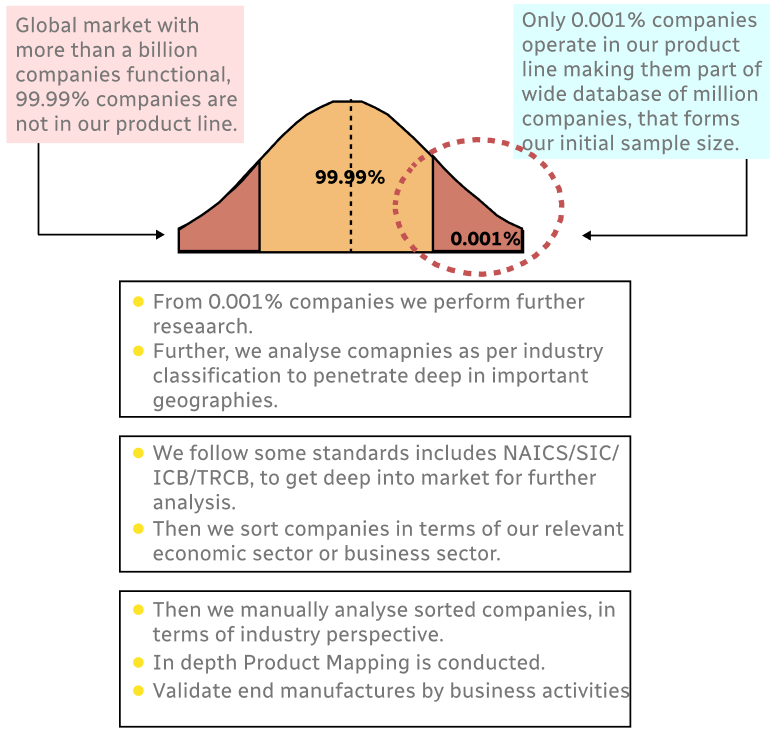
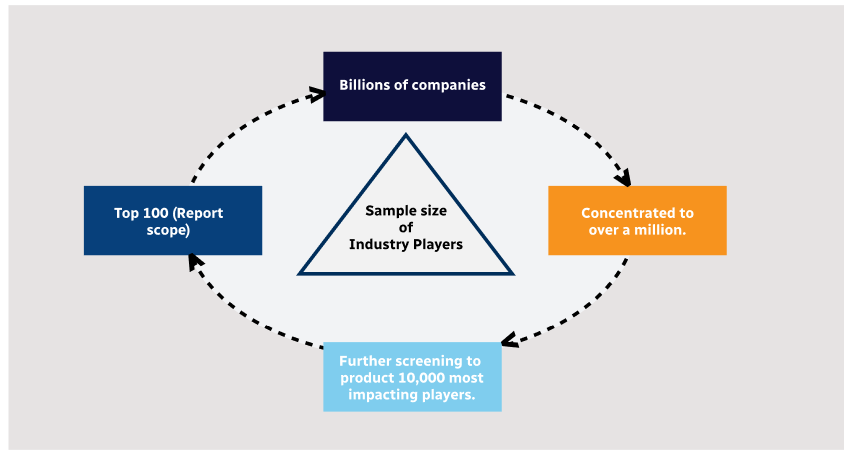
Step 1 - Identification of Relevant Samples Size from Population Database
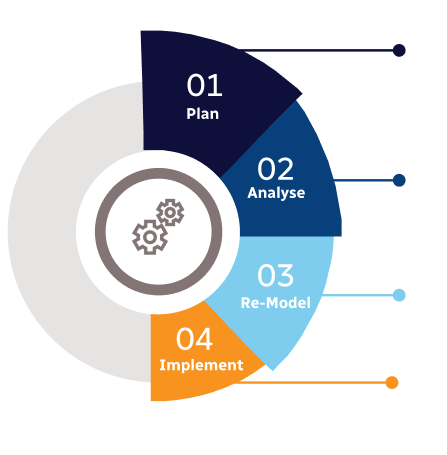
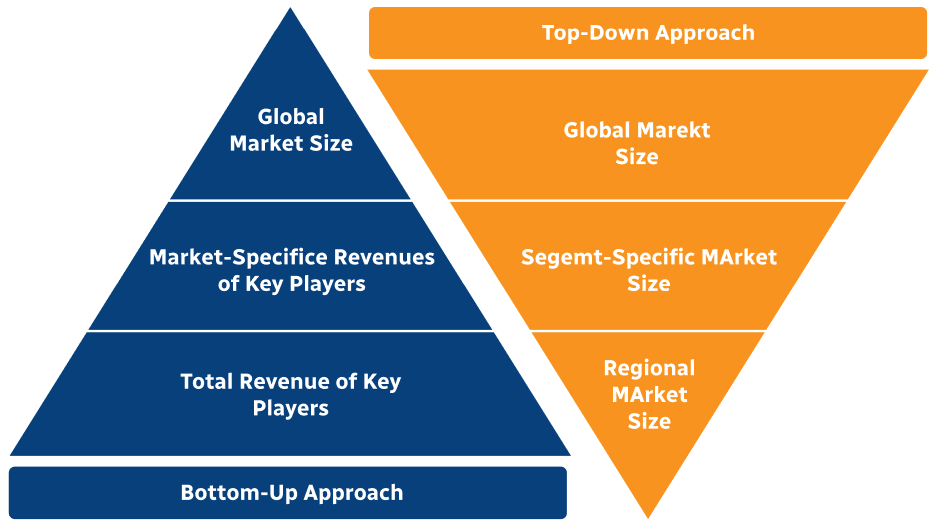
Step 2 - Approaches for Defining Global Market Size (Value, Volume* & Price*)
Note*: In applicable scenarios
Step 3 - Data Sources
Primary Research
- Web Analytics
- Survey Reports
- Research Institute
- Latest Research Reports
- Opinion Leaders
Secondary Research
- Annual Reports
- White Paper
- Latest Press Release
- Industry Association
- Paid Database
- Investor Presentations
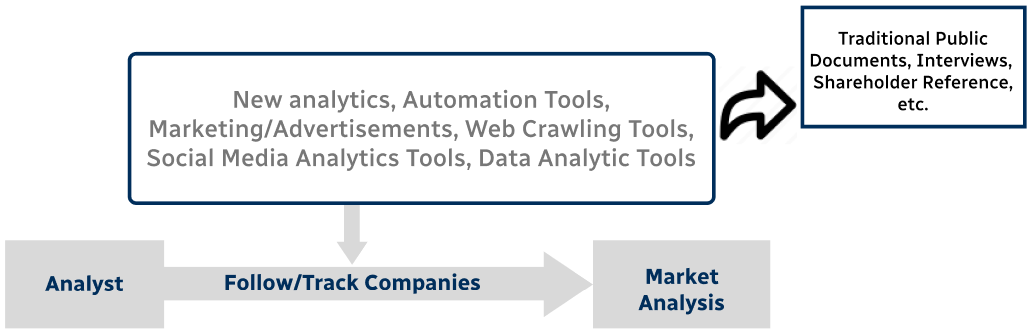
Step 4 - Data Triangulation
Involves using different sources of information in order to increase the validity of a study
These sources are likely to be stakeholders in a program - participants, other researchers, program staff, other community members, and so on.
Then we put all data in single framework & apply various statistical tools to find out the dynamic on the market.
During the analysis stage, feedback from the stakeholder groups would be compared to determine areas of agreement as well as areas of divergence