
Key Insights
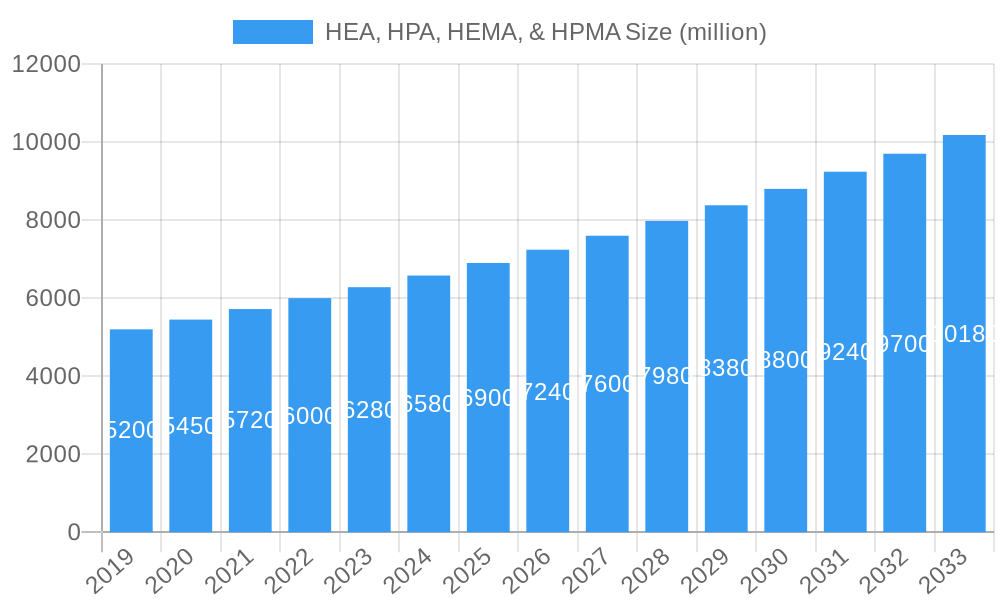
The global market for Hydroxypropyl Acrylate (HPA), 2-Hydroxyethyl Acrylate (HEA), Hydroxypropyl Methacrylate (HPMA), and 2-Hydroxyethyl Methacrylate (HEMA) is poised for significant expansion, projected to reach approximately $8.5 billion by 2033, growing at a Compound Annual Growth Rate (CAGR) of around 6.8%. This robust growth is primarily driven by the escalating demand from the paints and coatings industry, where these monomers are essential for formulating high-performance, low-VOC (Volatile Organic Compound) products. The construction sector's continuous expansion, coupled with increasing applications in plastics and rubbers for enhanced durability and flexibility, further bolsters market demand. Furthermore, the personal care segment is witnessing a rise in the use of these acrylates in cosmetics and skincare products due to their humectant and film-forming properties. The expanding industrial base in Asia Pacific, particularly in China and India, is a key regional growth engine, owing to rapid urbanization and infrastructure development.
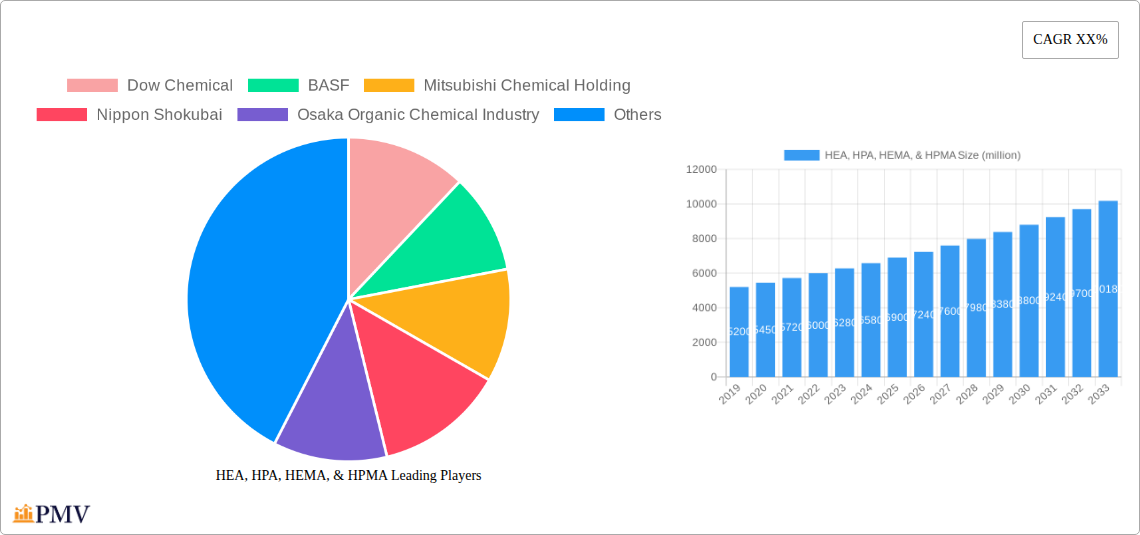
HEA, HPA, HEMA, & HPMA Market Size (In Billion)

Despite the promising outlook, certain restraints could temper the market's full potential. Fluctuations in raw material prices, particularly those linked to crude oil, can impact production costs and profitability. Stringent environmental regulations concerning chemical manufacturing and disposal may also pose challenges for some market players. However, ongoing technological advancements in polymerization techniques and the development of bio-based alternatives are expected to mitigate some of these concerns. The market is characterized by a competitive landscape with major players like Dow Chemical, BASF, and Mitsubishi Chemical Holding actively investing in research and development to introduce innovative products and expand their geographical reach. The forecast period indicates a steady upward trajectory, driven by the inherent versatility and performance benefits these hydroxyalkyl acrylates offer across a diverse range of industrial and consumer applications, with a notable emphasis on sustainable and high-performance solutions.
HEA, HPA, HEMA, & HPMA Company Market Share
HEA, HPA, HEMA, & HPMA Market Analysis Report: Global Outlook & Future Projections (2019-2033)
Unlock unparalleled insights into the dynamic HEA, HPA, HEMA, & HPMA market with this comprehensive report. Spanning from 2019 to 2033, with a base year of 2025 and a forecast period from 2025 to 2033, this analysis offers detailed market segmentation, key driver identification, challenge assessment, and strategic outlook. Leveraging extensive research, this report covers crucial segments including Paints & Coatings, Construction, Plastics & Rubbers, Personal Care, Adhesives, Printing Inks, Chemical Intermediates, and Others, alongside product types such as Hydroxypropyl Acrylate (HPA), 2-Hydroxyethyl Acrylate (HEA), Hydroxypropyl Methacrylate (HPMA), and 2-Hydroxyethyl Methacrylate (HEMA). Examine industry-leading companies like Dow Chemical, BASF, Mitsubishi Chemical Holding, Nippon Shokubai, Osaka Organic Chemical Industry, Röhm GmbH, Polysciences, Tokyo Chemical Industry, Changzhou Hickory Chemical, Monomer-Polymer & Dajac Labs, Heze Chang Sheng Yuan Technology, and Chizhou Fangda Science and Technology. This report is designed for chemical manufacturers, material suppliers, research and development professionals, market strategists, and investors seeking to capitalize on the substantial opportunities within the acrylates and methacrylates market.
HEA, HPA, HEMA, & HPMA Market Structure & Competitive Dynamics
The HEA, HPA, HEMA, & HPMA market exhibits a moderate to high level of market concentration, with key players like Dow Chemical and BASF holding significant market shares, estimated to be in the range of 15-20% each. The innovation ecosystem is driven by continuous R&D in developing novel applications and improving synthesis processes, with an estimated investment of over $500 million annually across leading companies. Regulatory frameworks, particularly concerning environmental impact and product safety, are becoming increasingly stringent, influencing product development and market entry strategies. Product substitutes, while present in some niche applications, generally do not offer the same performance characteristics as HEA, HPA, HEMA, and HPMA. End-user trends are largely shaped by the demand from the paints & coatings and construction industries, which are projected to account for over 40% of the total market demand. Merger and acquisition (M&A) activities are moderate, with strategic partnerships and smaller acquisitions valued in the range of $50 million to $200 million, aimed at expanding geographical reach or product portfolios. The competitive landscape is characterized by a blend of established global giants and emerging regional players, all striving for market dominance through technological advancements and cost-effective production.
HEA, HPA, HEMA, & HPMA Industry Trends & Insights
The HEA, HPA, HEMA, & HPMA industry is experiencing robust growth, driven by escalating demand from a diverse range of end-use sectors. The paints & coatings segment, a primary consumer, is witnessing significant expansion due to urbanization and infrastructure development globally, contributing to an estimated market share of 25-30%. Similarly, the construction industry's insatiable need for durable and high-performance materials fuels the demand for these acrylates and methacrylates in adhesives, sealants, and specialty coatings, accounting for approximately 20-25% of market consumption. Technological disruptions, such as advancements in polymerization techniques and the development of eco-friendly formulations, are reshaping product offerings and manufacturing processes. Consumer preferences are increasingly leaning towards sustainable and low-VOC (Volatile Organic Compound) products, prompting manufacturers to invest heavily in green chemistry and bio-based alternatives, an investment estimated to be over $300 million annually. The plastics & rubbers sector also presents a substantial opportunity, with HEA, HPA, HEMA, and HPMA being integral components in the production of various polymers, impacting everything from automotive parts to consumer goods. The overall market is projected to witness a Compound Annual Growth Rate (CAGR) of approximately 5.5% to 6.5% during the forecast period. Market penetration in emerging economies is on an upward trajectory, driven by industrialization and a growing middle class. The personal care industry is also a notable contributor, utilizing these compounds in cosmetics and skincare products, while printing inks benefit from their excellent adhesion and flexibility properties. The chemical intermediates segment remains a foundational pillar, supplying these versatile monomers for further chemical synthesis.
Dominant Markets & Segments in HEA, HPA, HEMA, & HPMA
The global HEA, HPA, HEMA, & HPMA market is dominated by the Asia Pacific region, with China emerging as the leading country due to its massive manufacturing base and robust demand from its burgeoning industrial sectors. Economic policies promoting industrial growth, coupled with significant investments in infrastructure, have propelled the construction and paints & coatings sectors to the forefront of consumption.
Application Dominance:
- Paints & Coatings: This segment holds the largest market share, estimated at over 25%, driven by the demand for high-performance, durable, and weather-resistant coatings in architectural, automotive, and industrial applications. The increasing use of waterborne coatings, where HEA and HEMA play a crucial role, further bolsters this segment.
- Construction: Following closely, the construction segment accounts for an estimated 20-25% of the market. HEA, HPA, HEMA, and HPMA are vital in the formulation of adhesives, sealants, concrete admixtures, and protective coatings, contributing to enhanced structural integrity and longevity.
- Plastics & Rubbers: This segment, representing around 15-20% of the market, utilizes these monomers for producing specialty polymers with improved properties like impact resistance and flexibility, finding applications in automotive, electronics, and consumer goods.
- Personal Care: While a smaller segment (estimated 5-7%), it is crucial for its use in cosmetics, nail polish, and hair care products, where properties like adhesion and film-forming are essential.
- Adhesives: This segment (estimated 10-12%) benefits from the excellent bonding capabilities of HEA, HPA, HEMA, and HPMA in various industrial and consumer adhesive formulations.
- Printing Inks: Contributing around 5-7%, this segment leverages the monomers for inks requiring good adhesion, flexibility, and fast drying times.
- Chemical Intermediates: This foundational segment (estimated 10-15%) supplies these monomers for a wide array of downstream chemical synthesis.
Type Dominance:
- 2-Hydroxyethyl Methacrylate (HEMA): This is often the most widely used type, particularly in paints & coatings and adhesives, due to its excellent reactivity and versatility.
- Hydroxypropyl Methacrylate (HPMA): HPMA offers enhanced flexibility and adhesion in specific applications within plastics & rubbers and coatings.
- 2-Hydroxyethyl Acrylate (HEA): HEA finds significant use in UV-curable coatings and inks, offering fast curing times.
- Hydroxypropyl Acrylate (HPA): HPA is employed in applications requiring specific solubility and reactivity profiles, often in specialty polymers and coatings.
The market's growth is significantly influenced by the downstream demand from these key application segments, with technological advancements in polymerization and formulation driving innovation and market expansion.
HEA, HPA, HEMA, & HPMA Product Innovations
Recent product innovations in the HEA, HPA, HEMA, & HPMA market are primarily focused on enhancing performance characteristics and sustainability. Developments include the introduction of ultra-low VOC acrylates for eco-friendly coatings and adhesives, as well as novel methacrylates designed for advanced UV-curable applications, offering faster cure speeds and improved scratch resistance. Companies are also investing in R&D for bio-based alternatives, aligning with growing environmental consciousness and regulatory pressures. These innovations aim to provide competitive advantages by meeting specific industry demands for enhanced durability, flexibility, and environmental compliance, thereby expanding market reach into new and existing applications.
Report Segmentation & Scope
This comprehensive report meticulously segments the HEA, HPA, HEMA, & HPMA market across its diverse applications and product types. The application segmentation includes Paints & Coatings, Construction, Plastics & Rubbers, Personal Care, Adhesives, Printing Inks, Chemical Intermediates, and Others. The product type segmentation covers Hydroxypropyl Acrylate (HPA), 2-Hydroxyethyl Acrylate (HEA), Hydroxypropyl Methacrylate (HPMA), and 2-Hydroxyethyl Methacrylate (HEMA). Each segment is analyzed for its market size, growth projections, and competitive dynamics, offering a granular view of opportunities and challenges within the broader market landscape. The scope encompasses a detailed historical analysis from 2019 to 2024 and a forward-looking forecast from 2025 to 2033.
Key Drivers of HEA, HPA, HEMA, & HPMA Growth
The growth of the HEA, HPA, HEMA, & HPMA market is propelled by several key drivers. Firstly, the robust expansion of the global paints & coatings industry, particularly in emerging economies driven by infrastructure development and increasing disposable incomes, fuels demand for these monomers as essential binders and functional additives. Secondly, the construction sector's continuous need for high-performance adhesives, sealants, and coatings contributes significantly. Technological advancements in polymerization processes and the increasing adoption of UV-curable technologies, which heavily utilize HEA and HEMA, are also major growth catalysts. Furthermore, evolving consumer preferences towards eco-friendly and sustainable products are driving innovation in low-VOC and bio-based formulations.
Challenges in the HEA, HPA, HEMA, & HPMA Sector
Despite significant growth, the HEA, HPA, HEMA, & HPMA sector faces several challenges. Stringent environmental regulations regarding VOC emissions and chemical handling can impact production costs and market access. Fluctuations in raw material prices, particularly petrochemical feedstocks, pose a risk to profit margins. Intense competition among established players and the emergence of new entrants can lead to pricing pressures. Supply chain disruptions, exacerbated by geopolitical events or natural disasters, can affect availability and lead times. Lastly, the development of alternative materials that offer comparable performance at a lower cost remains a potential threat in certain applications.
Leading Players in the HEA, HPA, HEMA, & HPMA Market
- Dow Chemical
- BASF
- Mitsubishi Chemical Holding
- Nippon Shokubai
- Osaka Organic Chemical Industry
- Röhm GmbH
- Polysciences
- Tokyo Chemical Industry
- Changzhou Hickory Chemical
- Monomer-Polymer & Dajac Labs
- Heze Chang Sheng Yuan Technology
- Chizhou Fangda Science and Technology
Key Developments in HEA, HPA, HEMA, & HPMA Sector
- 2023: Launch of new bio-based HEA grades by Röhm GmbH to meet growing demand for sustainable materials in coatings.
- 2023: BASF announces expansion of its acrylics production capacity in Asia Pacific to cater to increasing regional demand.
- 2022: Nippon Shokubai develops novel HEMA-based polymers for advanced dental materials, showcasing application diversification.
- 2021: Mitsubishi Chemical Holding strengthens its presence in the adhesives market through strategic partnerships for HEA and HPA derivatives.
- 2020: Dow Chemical introduces innovative HEA-functionalized resins for high-performance UV-curable inks, impacting the printing industry.
Strategic HEA, HPA, HEMA, & HPMA Market Outlook
The strategic outlook for the HEA, HPA, HEMA, & HPMA market remains highly positive, characterized by sustained demand from core applications and emerging opportunities. The increasing global emphasis on sustainability will drive innovation in bio-based and low-emission technologies, offering significant growth accelerators. Strategic investments in R&D for niche applications, such as advanced composites and biomedical materials, will further diversify revenue streams. Expansion into emerging markets, coupled with strategic collaborations and potential mergers and acquisitions, will be crucial for consolidating market position and capitalizing on regional growth pockets. The market is poised for continued expansion, driven by technological advancements and the indispensable role of these monomers in modern material science.
HEA, HPA, HEMA, & HPMA Segmentation
-
1. Application
- 1.1. Paints & Coatings
- 1.2. Construction
- 1.3. Plastics & Rubbers
- 1.4. Personal Care
- 1.5. Adhesives
- 1.6. Printing Inks
- 1.7. Chemical Intermediates
- 1.8. Others
-
2. Types
- 2.1. Hydroxypropyl Acrylate (HPA)
- 2.2. 2-Hydroxyethyl Acrylate (HEA)
- 2.3. Hydroxypropyl Methacrylate (HPMA)
- 2.4. 2-Hydroxyethyl Methacrylate (HEMA)
HEA, HPA, HEMA, & HPMA Segmentation By Geography
-
1. North America
- 1.1. United States
- 1.2. Canada
- 1.3. Mexico
-
2. South America
- 2.1. Brazil
- 2.2. Argentina
- 2.3. Rest of South America
-
3. Europe
- 3.1. United Kingdom
- 3.2. Germany
- 3.3. France
- 3.4. Italy
- 3.5. Spain
- 3.6. Russia
- 3.7. Benelux
- 3.8. Nordics
- 3.9. Rest of Europe
-
4. Middle East & Africa
- 4.1. Turkey
- 4.2. Israel
- 4.3. GCC
- 4.4. North Africa
- 4.5. South Africa
- 4.6. Rest of Middle East & Africa
-
5. Asia Pacific
- 5.1. China
- 5.2. India
- 5.3. Japan
- 5.4. South Korea
- 5.5. ASEAN
- 5.6. Oceania
- 5.7. Rest of Asia Pacific
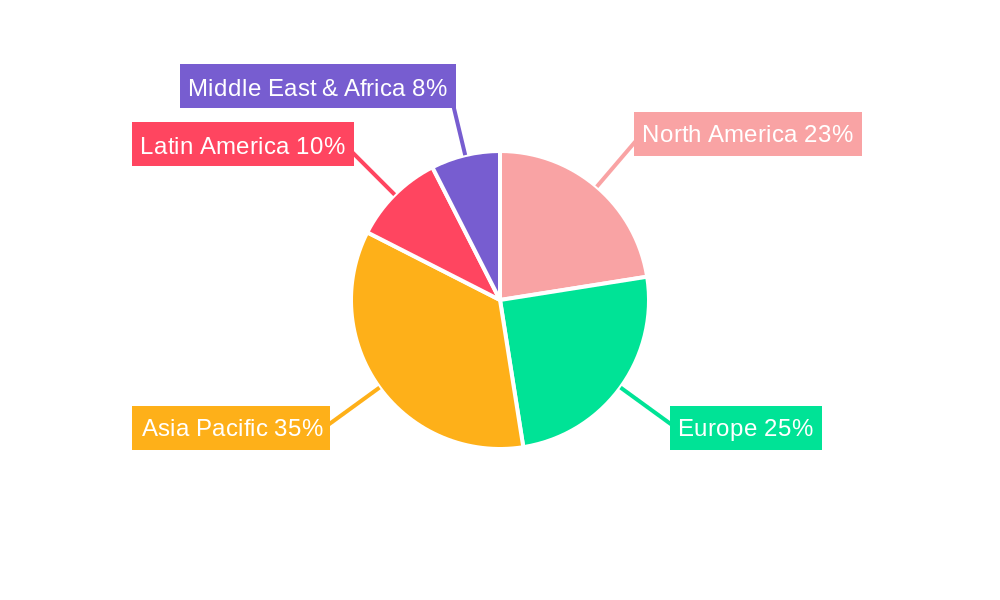
HEA, HPA, HEMA, & HPMA Regional Market Share
Geographic Coverage of HEA, HPA, HEMA, & HPMA
HEA, HPA, HEMA, & HPMA REPORT HIGHLIGHTS
| Aspects | Details |
|---|---|
| Study Period | 2020-2034 |
| Base Year | 2025 |
| Estimated Year | 2026 |
| Forecast Period | 2026-2034 |
| Historical Period | 2020-2025 |
| Growth Rate | CAGR of 3.96% from 2020-2034 |
| Segmentation |
|
Table of Contents
- 1. Introduction
- 1.1. Research Scope
- 1.2. Market Segmentation
- 1.3. Research Methodology
- 1.4. Definitions and Assumptions
- 2. Executive Summary
- 2.1. Introduction
- 3. Market Dynamics
- 3.1. Introduction
- 3.2. Market Drivers
- 3.3. Market Restrains
- 3.4. Market Trends
- 4. Market Factor Analysis
- 4.1. Porters Five Forces
- 4.2. Supply/Value Chain
- 4.3. PESTEL analysis
- 4.4. Market Entropy
- 4.5. Patent/Trademark Analysis
- 5. Global HEA, HPA, HEMA, & HPMA Analysis, Insights and Forecast, 2020-2032
- 5.1. Market Analysis, Insights and Forecast - by Application
- 5.1.1. Paints & Coatings
- 5.1.2. Construction
- 5.1.3. Plastics & Rubbers
- 5.1.4. Personal Care
- 5.1.5. Adhesives
- 5.1.6. Printing Inks
- 5.1.7. Chemical Intermediates
- 5.1.8. Others
- 5.2. Market Analysis, Insights and Forecast - by Types
- 5.2.1. Hydroxypropyl Acrylate (HPA)
- 5.2.2. 2-Hydroxyethyl Acrylate (HEA)
- 5.2.3. Hydroxypropyl Methacrylate (HPMA)
- 5.2.4. 2-Hydroxyethyl Methacrylate (HEMA)
- 5.3. Market Analysis, Insights and Forecast - by Region
- 5.3.1. North America
- 5.3.2. South America
- 5.3.3. Europe
- 5.3.4. Middle East & Africa
- 5.3.5. Asia Pacific
- 5.1. Market Analysis, Insights and Forecast - by Application
- 6. North America HEA, HPA, HEMA, & HPMA Analysis, Insights and Forecast, 2020-2032
- 6.1. Market Analysis, Insights and Forecast - by Application
- 6.1.1. Paints & Coatings
- 6.1.2. Construction
- 6.1.3. Plastics & Rubbers
- 6.1.4. Personal Care
- 6.1.5. Adhesives
- 6.1.6. Printing Inks
- 6.1.7. Chemical Intermediates
- 6.1.8. Others
- 6.2. Market Analysis, Insights and Forecast - by Types
- 6.2.1. Hydroxypropyl Acrylate (HPA)
- 6.2.2. 2-Hydroxyethyl Acrylate (HEA)
- 6.2.3. Hydroxypropyl Methacrylate (HPMA)
- 6.2.4. 2-Hydroxyethyl Methacrylate (HEMA)
- 6.1. Market Analysis, Insights and Forecast - by Application
- 7. South America HEA, HPA, HEMA, & HPMA Analysis, Insights and Forecast, 2020-2032
- 7.1. Market Analysis, Insights and Forecast - by Application
- 7.1.1. Paints & Coatings
- 7.1.2. Construction
- 7.1.3. Plastics & Rubbers
- 7.1.4. Personal Care
- 7.1.5. Adhesives
- 7.1.6. Printing Inks
- 7.1.7. Chemical Intermediates
- 7.1.8. Others
- 7.2. Market Analysis, Insights and Forecast - by Types
- 7.2.1. Hydroxypropyl Acrylate (HPA)
- 7.2.2. 2-Hydroxyethyl Acrylate (HEA)
- 7.2.3. Hydroxypropyl Methacrylate (HPMA)
- 7.2.4. 2-Hydroxyethyl Methacrylate (HEMA)
- 7.1. Market Analysis, Insights and Forecast - by Application
- 8. Europe HEA, HPA, HEMA, & HPMA Analysis, Insights and Forecast, 2020-2032
- 8.1. Market Analysis, Insights and Forecast - by Application
- 8.1.1. Paints & Coatings
- 8.1.2. Construction
- 8.1.3. Plastics & Rubbers
- 8.1.4. Personal Care
- 8.1.5. Adhesives
- 8.1.6. Printing Inks
- 8.1.7. Chemical Intermediates
- 8.1.8. Others
- 8.2. Market Analysis, Insights and Forecast - by Types
- 8.2.1. Hydroxypropyl Acrylate (HPA)
- 8.2.2. 2-Hydroxyethyl Acrylate (HEA)
- 8.2.3. Hydroxypropyl Methacrylate (HPMA)
- 8.2.4. 2-Hydroxyethyl Methacrylate (HEMA)
- 8.1. Market Analysis, Insights and Forecast - by Application
- 9. Middle East & Africa HEA, HPA, HEMA, & HPMA Analysis, Insights and Forecast, 2020-2032
- 9.1. Market Analysis, Insights and Forecast - by Application
- 9.1.1. Paints & Coatings
- 9.1.2. Construction
- 9.1.3. Plastics & Rubbers
- 9.1.4. Personal Care
- 9.1.5. Adhesives
- 9.1.6. Printing Inks
- 9.1.7. Chemical Intermediates
- 9.1.8. Others
- 9.2. Market Analysis, Insights and Forecast - by Types
- 9.2.1. Hydroxypropyl Acrylate (HPA)
- 9.2.2. 2-Hydroxyethyl Acrylate (HEA)
- 9.2.3. Hydroxypropyl Methacrylate (HPMA)
- 9.2.4. 2-Hydroxyethyl Methacrylate (HEMA)
- 9.1. Market Analysis, Insights and Forecast - by Application
- 10. Asia Pacific HEA, HPA, HEMA, & HPMA Analysis, Insights and Forecast, 2020-2032
- 10.1. Market Analysis, Insights and Forecast - by Application
- 10.1.1. Paints & Coatings
- 10.1.2. Construction
- 10.1.3. Plastics & Rubbers
- 10.1.4. Personal Care
- 10.1.5. Adhesives
- 10.1.6. Printing Inks
- 10.1.7. Chemical Intermediates
- 10.1.8. Others
- 10.2. Market Analysis, Insights and Forecast - by Types
- 10.2.1. Hydroxypropyl Acrylate (HPA)
- 10.2.2. 2-Hydroxyethyl Acrylate (HEA)
- 10.2.3. Hydroxypropyl Methacrylate (HPMA)
- 10.2.4. 2-Hydroxyethyl Methacrylate (HEMA)
- 10.1. Market Analysis, Insights and Forecast - by Application
- 11. Competitive Analysis
- 11.1. Global Market Share Analysis 2025
- 11.2. Company Profiles
- 11.2.1 Dow Chemical
- 11.2.1.1. Overview
- 11.2.1.2. Products
- 11.2.1.3. SWOT Analysis
- 11.2.1.4. Recent Developments
- 11.2.1.5. Financials (Based on Availability)
- 11.2.2 BASF
- 11.2.2.1. Overview
- 11.2.2.2. Products
- 11.2.2.3. SWOT Analysis
- 11.2.2.4. Recent Developments
- 11.2.2.5. Financials (Based on Availability)
- 11.2.3 Mitsubishi Chemical Holding
- 11.2.3.1. Overview
- 11.2.3.2. Products
- 11.2.3.3. SWOT Analysis
- 11.2.3.4. Recent Developments
- 11.2.3.5. Financials (Based on Availability)
- 11.2.4 Nippon Shokubai
- 11.2.4.1. Overview
- 11.2.4.2. Products
- 11.2.4.3. SWOT Analysis
- 11.2.4.4. Recent Developments
- 11.2.4.5. Financials (Based on Availability)
- 11.2.5 Osaka Organic Chemical Industry
- 11.2.5.1. Overview
- 11.2.5.2. Products
- 11.2.5.3. SWOT Analysis
- 11.2.5.4. Recent Developments
- 11.2.5.5. Financials (Based on Availability)
- 11.2.6 Röhm GmbH
- 11.2.6.1. Overview
- 11.2.6.2. Products
- 11.2.6.3. SWOT Analysis
- 11.2.6.4. Recent Developments
- 11.2.6.5. Financials (Based on Availability)
- 11.2.7 Polysciences
- 11.2.7.1. Overview
- 11.2.7.2. Products
- 11.2.7.3. SWOT Analysis
- 11.2.7.4. Recent Developments
- 11.2.7.5. Financials (Based on Availability)
- 11.2.8 Tokyo Chemical Industry
- 11.2.8.1. Overview
- 11.2.8.2. Products
- 11.2.8.3. SWOT Analysis
- 11.2.8.4. Recent Developments
- 11.2.8.5. Financials (Based on Availability)
- 11.2.9 Changzhou Hickory Chemical
- 11.2.9.1. Overview
- 11.2.9.2. Products
- 11.2.9.3. SWOT Analysis
- 11.2.9.4. Recent Developments
- 11.2.9.5. Financials (Based on Availability)
- 11.2.10 Monomer-Polymer & Dajac Labs
- 11.2.10.1. Overview
- 11.2.10.2. Products
- 11.2.10.3. SWOT Analysis
- 11.2.10.4. Recent Developments
- 11.2.10.5. Financials (Based on Availability)
- 11.2.11 Heze Chang Sheng Yuan Technology
- 11.2.11.1. Overview
- 11.2.11.2. Products
- 11.2.11.3. SWOT Analysis
- 11.2.11.4. Recent Developments
- 11.2.11.5. Financials (Based on Availability)
- 11.2.12 Chizhou Fangda Science and Technology
- 11.2.12.1. Overview
- 11.2.12.2. Products
- 11.2.12.3. SWOT Analysis
- 11.2.12.4. Recent Developments
- 11.2.12.5. Financials (Based on Availability)
- 11.2.1 Dow Chemical
List of Figures
- Figure 1: Global HEA, HPA, HEMA, & HPMA Revenue Breakdown (undefined, %) by Region 2025 & 2033
- Figure 2: North America HEA, HPA, HEMA, & HPMA Revenue (undefined), by Application 2025 & 2033
- Figure 3: North America HEA, HPA, HEMA, & HPMA Revenue Share (%), by Application 2025 & 2033
- Figure 4: North America HEA, HPA, HEMA, & HPMA Revenue (undefined), by Types 2025 & 2033
- Figure 5: North America HEA, HPA, HEMA, & HPMA Revenue Share (%), by Types 2025 & 2033
- Figure 6: North America HEA, HPA, HEMA, & HPMA Revenue (undefined), by Country 2025 & 2033
- Figure 7: North America HEA, HPA, HEMA, & HPMA Revenue Share (%), by Country 2025 & 2033
- Figure 8: South America HEA, HPA, HEMA, & HPMA Revenue (undefined), by Application 2025 & 2033
- Figure 9: South America HEA, HPA, HEMA, & HPMA Revenue Share (%), by Application 2025 & 2033
- Figure 10: South America HEA, HPA, HEMA, & HPMA Revenue (undefined), by Types 2025 & 2033
- Figure 11: South America HEA, HPA, HEMA, & HPMA Revenue Share (%), by Types 2025 & 2033
- Figure 12: South America HEA, HPA, HEMA, & HPMA Revenue (undefined), by Country 2025 & 2033
- Figure 13: South America HEA, HPA, HEMA, & HPMA Revenue Share (%), by Country 2025 & 2033
- Figure 14: Europe HEA, HPA, HEMA, & HPMA Revenue (undefined), by Application 2025 & 2033
- Figure 15: Europe HEA, HPA, HEMA, & HPMA Revenue Share (%), by Application 2025 & 2033
- Figure 16: Europe HEA, HPA, HEMA, & HPMA Revenue (undefined), by Types 2025 & 2033
- Figure 17: Europe HEA, HPA, HEMA, & HPMA Revenue Share (%), by Types 2025 & 2033
- Figure 18: Europe HEA, HPA, HEMA, & HPMA Revenue (undefined), by Country 2025 & 2033
- Figure 19: Europe HEA, HPA, HEMA, & HPMA Revenue Share (%), by Country 2025 & 2033
- Figure 20: Middle East & Africa HEA, HPA, HEMA, & HPMA Revenue (undefined), by Application 2025 & 2033
- Figure 21: Middle East & Africa HEA, HPA, HEMA, & HPMA Revenue Share (%), by Application 2025 & 2033
- Figure 22: Middle East & Africa HEA, HPA, HEMA, & HPMA Revenue (undefined), by Types 2025 & 2033
- Figure 23: Middle East & Africa HEA, HPA, HEMA, & HPMA Revenue Share (%), by Types 2025 & 2033
- Figure 24: Middle East & Africa HEA, HPA, HEMA, & HPMA Revenue (undefined), by Country 2025 & 2033
- Figure 25: Middle East & Africa HEA, HPA, HEMA, & HPMA Revenue Share (%), by Country 2025 & 2033
- Figure 26: Asia Pacific HEA, HPA, HEMA, & HPMA Revenue (undefined), by Application 2025 & 2033
- Figure 27: Asia Pacific HEA, HPA, HEMA, & HPMA Revenue Share (%), by Application 2025 & 2033
- Figure 28: Asia Pacific HEA, HPA, HEMA, & HPMA Revenue (undefined), by Types 2025 & 2033
- Figure 29: Asia Pacific HEA, HPA, HEMA, & HPMA Revenue Share (%), by Types 2025 & 2033
- Figure 30: Asia Pacific HEA, HPA, HEMA, & HPMA Revenue (undefined), by Country 2025 & 2033
- Figure 31: Asia Pacific HEA, HPA, HEMA, & HPMA Revenue Share (%), by Country 2025 & 2033
List of Tables
- Table 1: Global HEA, HPA, HEMA, & HPMA Revenue undefined Forecast, by Application 2020 & 2033
- Table 2: Global HEA, HPA, HEMA, & HPMA Revenue undefined Forecast, by Types 2020 & 2033
- Table 3: Global HEA, HPA, HEMA, & HPMA Revenue undefined Forecast, by Region 2020 & 2033
- Table 4: Global HEA, HPA, HEMA, & HPMA Revenue undefined Forecast, by Application 2020 & 2033
- Table 5: Global HEA, HPA, HEMA, & HPMA Revenue undefined Forecast, by Types 2020 & 2033
- Table 6: Global HEA, HPA, HEMA, & HPMA Revenue undefined Forecast, by Country 2020 & 2033
- Table 7: United States HEA, HPA, HEMA, & HPMA Revenue (undefined) Forecast, by Application 2020 & 2033
- Table 8: Canada HEA, HPA, HEMA, & HPMA Revenue (undefined) Forecast, by Application 2020 & 2033
- Table 9: Mexico HEA, HPA, HEMA, & HPMA Revenue (undefined) Forecast, by Application 2020 & 2033
- Table 10: Global HEA, HPA, HEMA, & HPMA Revenue undefined Forecast, by Application 2020 & 2033
- Table 11: Global HEA, HPA, HEMA, & HPMA Revenue undefined Forecast, by Types 2020 & 2033
- Table 12: Global HEA, HPA, HEMA, & HPMA Revenue undefined Forecast, by Country 2020 & 2033
- Table 13: Brazil HEA, HPA, HEMA, & HPMA Revenue (undefined) Forecast, by Application 2020 & 2033
- Table 14: Argentina HEA, HPA, HEMA, & HPMA Revenue (undefined) Forecast, by Application 2020 & 2033
- Table 15: Rest of South America HEA, HPA, HEMA, & HPMA Revenue (undefined) Forecast, by Application 2020 & 2033
- Table 16: Global HEA, HPA, HEMA, & HPMA Revenue undefined Forecast, by Application 2020 & 2033
- Table 17: Global HEA, HPA, HEMA, & HPMA Revenue undefined Forecast, by Types 2020 & 2033
- Table 18: Global HEA, HPA, HEMA, & HPMA Revenue undefined Forecast, by Country 2020 & 2033
- Table 19: United Kingdom HEA, HPA, HEMA, & HPMA Revenue (undefined) Forecast, by Application 2020 & 2033
- Table 20: Germany HEA, HPA, HEMA, & HPMA Revenue (undefined) Forecast, by Application 2020 & 2033
- Table 21: France HEA, HPA, HEMA, & HPMA Revenue (undefined) Forecast, by Application 2020 & 2033
- Table 22: Italy HEA, HPA, HEMA, & HPMA Revenue (undefined) Forecast, by Application 2020 & 2033
- Table 23: Spain HEA, HPA, HEMA, & HPMA Revenue (undefined) Forecast, by Application 2020 & 2033
- Table 24: Russia HEA, HPA, HEMA, & HPMA Revenue (undefined) Forecast, by Application 2020 & 2033
- Table 25: Benelux HEA, HPA, HEMA, & HPMA Revenue (undefined) Forecast, by Application 2020 & 2033
- Table 26: Nordics HEA, HPA, HEMA, & HPMA Revenue (undefined) Forecast, by Application 2020 & 2033
- Table 27: Rest of Europe HEA, HPA, HEMA, & HPMA Revenue (undefined) Forecast, by Application 2020 & 2033
- Table 28: Global HEA, HPA, HEMA, & HPMA Revenue undefined Forecast, by Application 2020 & 2033
- Table 29: Global HEA, HPA, HEMA, & HPMA Revenue undefined Forecast, by Types 2020 & 2033
- Table 30: Global HEA, HPA, HEMA, & HPMA Revenue undefined Forecast, by Country 2020 & 2033
- Table 31: Turkey HEA, HPA, HEMA, & HPMA Revenue (undefined) Forecast, by Application 2020 & 2033
- Table 32: Israel HEA, HPA, HEMA, & HPMA Revenue (undefined) Forecast, by Application 2020 & 2033
- Table 33: GCC HEA, HPA, HEMA, & HPMA Revenue (undefined) Forecast, by Application 2020 & 2033
- Table 34: North Africa HEA, HPA, HEMA, & HPMA Revenue (undefined) Forecast, by Application 2020 & 2033
- Table 35: South Africa HEA, HPA, HEMA, & HPMA Revenue (undefined) Forecast, by Application 2020 & 2033
- Table 36: Rest of Middle East & Africa HEA, HPA, HEMA, & HPMA Revenue (undefined) Forecast, by Application 2020 & 2033
- Table 37: Global HEA, HPA, HEMA, & HPMA Revenue undefined Forecast, by Application 2020 & 2033
- Table 38: Global HEA, HPA, HEMA, & HPMA Revenue undefined Forecast, by Types 2020 & 2033
- Table 39: Global HEA, HPA, HEMA, & HPMA Revenue undefined Forecast, by Country 2020 & 2033
- Table 40: China HEA, HPA, HEMA, & HPMA Revenue (undefined) Forecast, by Application 2020 & 2033
- Table 41: India HEA, HPA, HEMA, & HPMA Revenue (undefined) Forecast, by Application 2020 & 2033
- Table 42: Japan HEA, HPA, HEMA, & HPMA Revenue (undefined) Forecast, by Application 2020 & 2033
- Table 43: South Korea HEA, HPA, HEMA, & HPMA Revenue (undefined) Forecast, by Application 2020 & 2033
- Table 44: ASEAN HEA, HPA, HEMA, & HPMA Revenue (undefined) Forecast, by Application 2020 & 2033
- Table 45: Oceania HEA, HPA, HEMA, & HPMA Revenue (undefined) Forecast, by Application 2020 & 2033
- Table 46: Rest of Asia Pacific HEA, HPA, HEMA, & HPMA Revenue (undefined) Forecast, by Application 2020 & 2033
Frequently Asked Questions
1. What is the projected Compound Annual Growth Rate (CAGR) of the HEA, HPA, HEMA, & HPMA?
The projected CAGR is approximately 3.96%.
2. Which companies are prominent players in the HEA, HPA, HEMA, & HPMA?
Key companies in the market include Dow Chemical, BASF, Mitsubishi Chemical Holding, Nippon Shokubai, Osaka Organic Chemical Industry, Röhm GmbH, Polysciences, Tokyo Chemical Industry, Changzhou Hickory Chemical, Monomer-Polymer & Dajac Labs, Heze Chang Sheng Yuan Technology, Chizhou Fangda Science and Technology.
3. What are the main segments of the HEA, HPA, HEMA, & HPMA?
The market segments include Application, Types.
4. Can you provide details about the market size?
The market size is estimated to be USD XXX N/A as of 2022.
5. What are some drivers contributing to market growth?
N/A
6. What are the notable trends driving market growth?
N/A
7. Are there any restraints impacting market growth?
N/A
8. Can you provide examples of recent developments in the market?
N/A
9. What pricing options are available for accessing the report?
Pricing options include single-user, multi-user, and enterprise licenses priced at USD 4900.00, USD 7350.00, and USD 9800.00 respectively.
10. Is the market size provided in terms of value or volume?
The market size is provided in terms of value, measured in N/A.
11. Are there any specific market keywords associated with the report?
Yes, the market keyword associated with the report is "HEA, HPA, HEMA, & HPMA," which aids in identifying and referencing the specific market segment covered.
12. How do I determine which pricing option suits my needs best?
The pricing options vary based on user requirements and access needs. Individual users may opt for single-user licenses, while businesses requiring broader access may choose multi-user or enterprise licenses for cost-effective access to the report.
13. Are there any additional resources or data provided in the HEA, HPA, HEMA, & HPMA report?
While the report offers comprehensive insights, it's advisable to review the specific contents or supplementary materials provided to ascertain if additional resources or data are available.
14. How can I stay updated on further developments or reports in the HEA, HPA, HEMA, & HPMA?
To stay informed about further developments, trends, and reports in the HEA, HPA, HEMA, & HPMA, consider subscribing to industry newsletters, following relevant companies and organizations, or regularly checking reputable industry news sources and publications.
Methodology
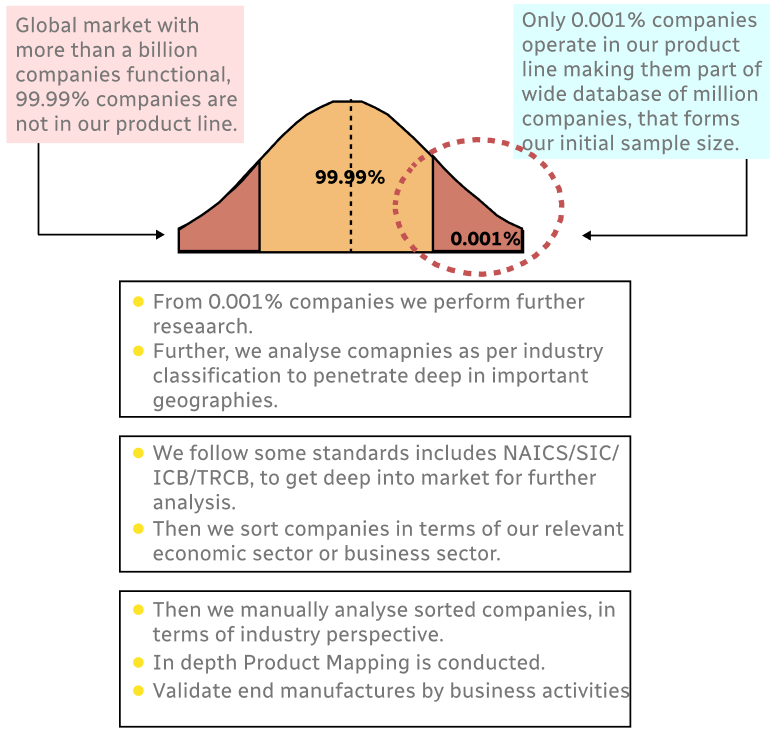
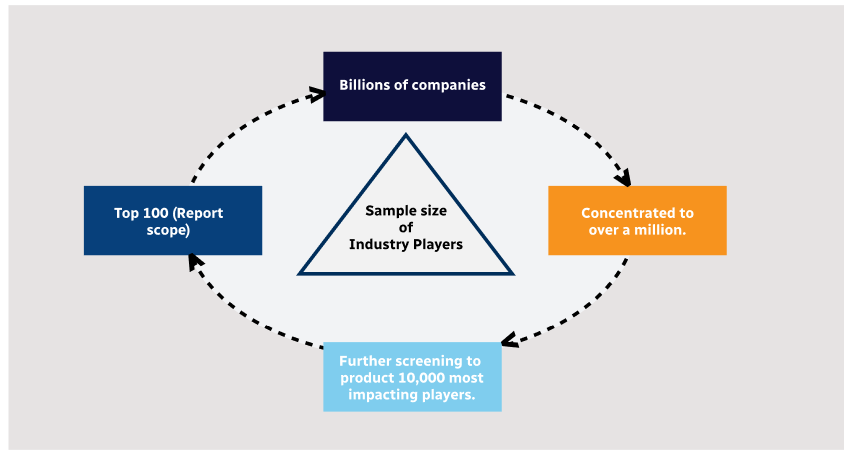
Step 1 - Identification of Relevant Samples Size from Population Database
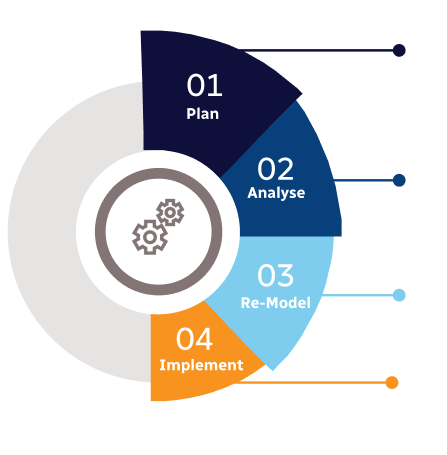
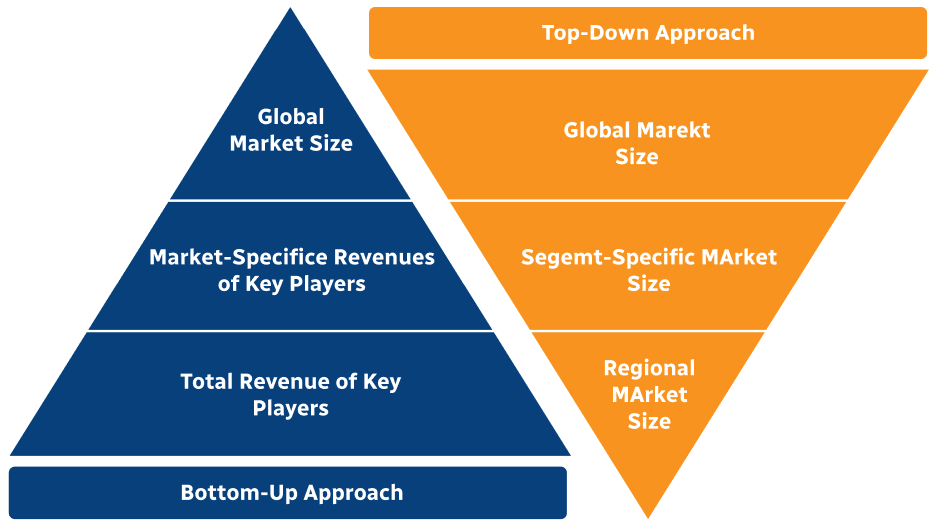
Step 2 - Approaches for Defining Global Market Size (Value, Volume* & Price*)
Note*: In applicable scenarios
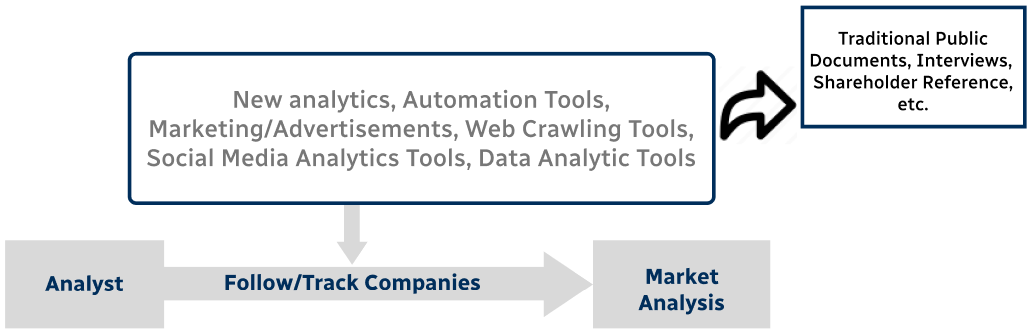
Step 3 - Data Sources
Primary Research
- Web Analytics
- Survey Reports
- Research Institute
- Latest Research Reports
- Opinion Leaders
Secondary Research
- Annual Reports
- White Paper
- Latest Press Release
- Industry Association
- Paid Database
- Investor Presentations
Step 4 - Data Triangulation
Involves using different sources of information in order to increase the validity of a study
These sources are likely to be stakeholders in a program - participants, other researchers, program staff, other community members, and so on.
Then we put all data in single framework & apply various statistical tools to find out the dynamic on the market.
During the analysis stage, feedback from the stakeholder groups would be compared to determine areas of agreement as well as areas of divergence